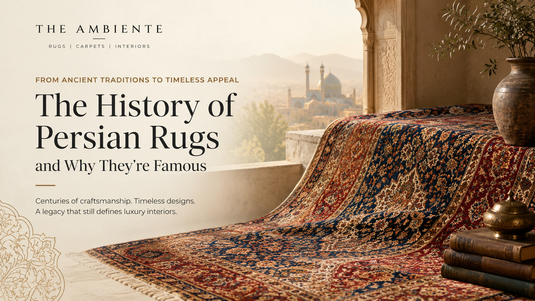
Persian rugs are among the most recognised forms of handmade textile art in the world. Known for intricate patterns, carefully balanced colours, skilled craftsmanship and centuries-old weaving traditions, Persian rugs have become much more than floor coverings. They are works of art, cultural objects and important expressions of the history of the regions where they were made.
From elaborate floral designs and central medallions to hunting scenes, geometric compositions and richly detailed borders, Persian rugs have influenced interior design across generations. Their appeal has extended from royal courts and religious institutions to European palaces, museums, luxury residences, hotels and contemporary interiors.
But what makes Persian rugs so famous? And how did a functional textile become one of the world's most celebrated forms of decorative art? The answer lies in a combination of history, craftsmanship, regional traditions, design, materials and cultural exchange.
What Is a Persian Rug?
A Persian rug is traditionally a handmade carpet or rug produced in the historical and cultural region of Persia, broadly corresponding to modern-day Iran. The term is commonly associated with hand-knotted pile rugs, although Persian carpet traditions include a wide range of weaving techniques, materials, patterns and regional styles.
One of the defining characteristics of Persian rugs is that they are closely connected to the place and community where they are made. Different weaving centres developed their own approaches to colour, motifs, knotting, proportions and composition.
For example, carpets associated with cities such as Tabriz, Kashan, Isfahan, Kerman and Herat have historically been distinguished by different design traditions. Tribal and village rugs can also have very different visual languages from carpets produced in urban workshops.
This regional diversity is one reason it is difficult to describe a Persian rug using a single design formula. Persian rugs can be floral, geometric, pictorial, symmetrical, asymmetrical, highly formal or comparatively spontaneous. Some are created according to carefully planned designs, while certain tribal weaving traditions allow the weaver considerably more freedom during the process.
How Old Is the Persian Rug Tradition?
The history of carpet weaving in Persia extends back many centuries. Written accounts, archaeological evidence and artistic representations indicate that carpets and other woven textiles had an important place in Persian culture long before the famous carpets of the Safavid period. However, there is an important historical limitation: relatively few very early Persian carpets have survived.
Textiles are vulnerable to moisture, insects, physical wear and environmental conditions. A carpet that was used for generations could eventually disappear even if the tradition that produced it continued. This means historians often use paintings, written descriptions and later surviving examples to understand earlier carpet traditions. By the 15th and 16th centuries, Persian carpet weaving had developed into a highly sophisticated art. The transformation became particularly significant under the Safavid dynasty.
The Safavid Era: A Golden Age of Persian Carpets
The Safavid dynasty ruled Persia from the early 16th century and played a major role in transforming carpet weaving into a highly developed court art. The 16th and 17th centuries are often regarded as a high point in Persian carpet design and production. Royal patronage, skilled designers, specialised workshops, access to high-quality materials and expanding international trade helped elevate carpets to an extraordinary level of artistic sophistication.
Royal workshops produced carpets for palaces and important institutions, while other workshops produced carpets for commercial markets. During this period, designers working across different artistic disciplines influenced one another. Carpet designs shared visual elements with Persian miniature painting, manuscript illumination, architectural decoration and other decorative arts.
Central medallions, elaborate floral scrolls, palmettes, hunting scenes and complex borders became important elements of Persian carpet design.
The Metropolitan Museum of Art notes that complex new techniques and designs developed during the Safavid period, including central medallions, floral compositions and elaborate borders. Under Shah Abbas I, luxurious carpets using silk and metal-wrapped threads were also produced for royal interiors, diplomatic gifts and export markets. This connection between carpets and courtly art is one of the reasons Safavid carpets remain so important to the history of decorative arts.
The Famous Ardabil Carpet
One of the most celebrated examples of Persian carpet history is the Ardabil Carpet. Made in Iran between 1539 and 1540, the carpet is associated with the town of Ardabil in north-western Iran and the Safavid period. It contains an inscription that includes the date and the name of the person associated with its production.
The carpet is now housed at the Victoria and Albert Museum in London and is regarded as one of the world's most historically important carpets. The Ardabil Carpet is particularly famous for its sophisticated composition. A large central medallion dominates the field, surrounded by intricate floral ornament and an elaborate border.
Its design demonstrates how Persian carpet makers could create a sense of balance across a very large surface while maintaining extraordinary detail. The carpet is also important because it demonstrates the connection between weaving, poetry, spirituality and courtly culture during the Safavid period.
Why Are Persian Rugs Famous?
There is no single reason for the global reputation of Persian rugs. Their fame comes from several qualities working together.
1. Centuries of craftsmanship
Persian rug weaving developed through generations of knowledge. Skills relating to spinning, dyeing, designing, knotting, weaving, finishing and washing were passed from one generation to another. In traditional weaving communities, knowledge was not simply written down. Much of it was learned through observation and practice.
UNESCO's documentation of carpet weaving traditions in Kashan, for example, describes skills being transmitted through apprenticeship and family teaching, including knowledge of design, dyeing, weaving and associated tools. This continuity gives handmade Persian rugs a cultural depth that mass-produced floor coverings cannot easily reproduce.
2. Intricate designs
Persian rugs are famous for their detailed patterns. Common design elements include:
- Floral motifs
- Vines and scrolling branches
- Palmettes
- Leaves
- Central medallions
- Geometric motifs
- Garden compositions
- Hunting scenes
- Animal figures
- Pictorial imagery
- Elaborate borders
The designs can be extraordinarily detailed without appearing visually chaotic. This balance between complexity and order is one of the characteristics that makes Persian rugs so appealing to collectors and interior designers.
3. Sophisticated colour palettes
Colour is another defining feature of Persian rugs. Traditional carpets often use deep reds, indigo blues, ivory, greens, browns and warm earth tones. Depending on the region and period, colours may be intense and saturated or softer and more muted.
Traditional natural dyes could be produced from materials such as madder root, indigo, walnut skins, pomegranate skins and other plant-based sources.
The use of natural dyes also contributes to the visual character associated with many historic carpets. Over time, colours can change subtly as a carpet is exposed to light and use. This ageing process can produce the gentle variation that collectors often appreciate.
4. Handmade construction
A handmade rug is fundamentally different from a mass-produced machine-made carpet. In a hand-knotted Persian rug, individual knots are tied to the foundation of the carpet. Row by row, the structure develops until the intended design is completed.
This can be a remarkably time-consuming process. The amount of work involved depends on the size, knot density, design complexity, materials and skill of the weaver. The result is not simply a printed image on a surface. The pattern is integrated into the structure of the rug itself.
5. Regional identity
Persian rugs are not all alike. Different regions developed distinctive approaches to weaving.
For example, carpets associated with:
Tabriz are often known for sophisticated compositions, medallions, floral patterns and detailed workmanship.
Kashan has a long association with fine carpets and is particularly known for detailed floral designs and refined knotting.
Isfahan became an important centre of Persian art and carpet production, particularly during and after the Safavid period.
Kerman is associated with elaborate floral compositions and a wide variety of carpet designs.
Fars is particularly important for tribal and nomadic weaving traditions, where carpets can reflect the weavers' environment and way of life. This regional diversity makes Persian rugs a broad family of traditions rather than a single visual style.
The Importance of Kashan
Kashan deserves particular attention when discussing Persian rugs. UNESCO has recognised the traditional skills of carpet weaving in Kashan as Intangible Cultural Heritage. The tradition includes distinctive approaches to design, weaving, dyeing and knotting.
Kashan carpets traditionally use cotton or silk in the foundation and may use wool or silk for the pile. The Farsi knot, also known as an asymmetrical knot, is an important feature of the weaving tradition. Traditional colour sources have included madder root, walnut skin, pomegranate skin and vine leaves.
Perhaps even more important is the way the knowledge is transmitted. The skills are learned through apprenticeship and family traditions, demonstrating that carpet weaving is not merely a manufacturing process. It is a form of cultural knowledge.
Persian Rugs and the Silk Road
Trade played a major role in the international history of Persian carpets. Persia was positioned within networks connecting Asia, the Middle East and Europe. Textiles, spices, ceramics, manuscripts and other luxury goods travelled through these commercial routes.
Carpets eventually became important trade commodities. During the Safavid period, Persian rugs increasingly reached markets outside Persia. European merchants and trading companies became involved in the carpet trade, helping introduce Persian carpets to new audiences.
The appeal was understandable. European buyers encountered carpets with sophisticated compositions, luxurious materials and colours that differed from many locally produced textiles. Persian rugs became associated with wealth, refinement and international luxury.
Persian Rugs in European Interiors
As Persian carpets entered European markets, they began appearing in aristocratic homes, palaces and other prestigious settings. Their influence also extended into European art. Paintings from different periods sometimes depict carpets, allowing historians to study how these textiles were used and how their designs were perceived.
Persian carpets were particularly attractive as luxury decorative objects because they could combine practical function with artistic value. A carpet could cover a floor while simultaneously functioning as a major visual element within an interior. That dual purpose remains relevant today.
Persian Rugs as Works of Art
One of the most interesting things about Persian rugs is the way they occupy several categories simultaneously.
They are:
- Functional objects
- Textiles
- Decorative art
- Cultural artefacts
- Craft objects
- Collectibles
- Design elements
A beautifully made Persian rug can completely alter the character of a room. Its colours can establish a palette. Its border can frame furniture. Its central design can create a visual focal point. Its texture can add warmth and depth. This is why rugs have historically played such an important role in interior architecture.
What Makes a Persian Rug Valuable?
Not every Persian rug has the same value. Several factors can influence the desirability and market value of an individual rug.
Age
Older rugs may be highly valued, particularly when their provenance and condition are well documented. However, age alone does not automatically make a carpet valuable.
Knot density
A higher knot density can allow a weaver to create finer details, although knot count should never be considered the only measure of quality.
Materials
Wool, silk and combinations of different fibres can produce different textures, visual effects and levels of refinement.
Design
Rare, historically significant or particularly sophisticated designs can increase interest among collectors.
Condition
The preservation of a rug is important. Excessive wear, repairs, fading or structural damage can affect its value.
Provenance
Documentation showing where a carpet came from, who owned it or where it was exhibited can add historical significance.
Craftsmanship
The precision of the weaving, quality of materials, finishing and overall construction all contribute to the character of a handmade carpet.
Persian Rugs and Natural Dyes
Natural dyes have historically played an important role in Persian carpet traditions. Madder can produce red tones, while indigo can create blues. Walnut skins and other botanical materials can contribute brown, yellow or darker shades.
The exact colour achieved depends on the dye material, preparation, fibre, water, temperature and dyeing process. This is one reason traditional carpets can display subtle variations rather than perfectly uniform colours. Such variation can contribute to the visual depth of a handmade rug.
Persian Rugs and Storytelling
Persian rugs often communicate more than decoration. Floral motifs can suggest gardens and nature. Hunting scenes can depict movement, animals and human activity. Geometric compositions can express rhythm and order. Garden carpets may evoke an idealised landscape. In tribal traditions, designs can reflect the environment and experiences of the communities that created them.
UNESCO's documentation of carpet weaving in Fars notes that weavers may incorporate scenes from nomadic life into their carpets. This storytelling quality is one of the reasons handmade rugs can feel deeply personal within an interior.
Why Persian Rugs Still Influence Modern Interior Design
Although Persian rugs have a long history, their visual language remains relevant to contemporary interiors. Interior designers frequently use traditional-inspired rugs alongside modern furniture, clean architectural lines and minimalist spaces. A richly patterned rug can introduce warmth into a neutral room.
A faded traditional design can add character without overwhelming a contemporary interior. A geometric Persian-inspired design can complement modern furniture. And a restrained floral pattern can work particularly well within transitional interiors. The key is not necessarily to reproduce a historic interior. Instead, designers can use the visual vocabulary of Persian rugs in new ways.
Persian Rugs and the Idea of Quiet Luxury
The renewed interest in craftsmanship and natural materials has also contributed to the continued appeal of traditional rugs. Modern luxury interiors increasingly value:
- Craftsmanship
- Material quality
- Longevity
- Authenticity
- Texture
- Cultural heritage
- Individuality
A handmade rug can support all of these characteristics. Unlike a mass-produced decorative object, a hand-crafted rug carries evidence of the process through which it was created.
Subtle variations in texture, colour and pattern can become part of its personality. This makes handmade rugs particularly suitable for interiors where the goal is sophistication without excessive visual noise.
Persian-Inspired Rugs in Contemporary Spaces
The influence of Persian design extends beyond rugs made in Iran. Designers around the world have drawn inspiration from Persian motifs, colour palettes and compositions. Today, Persian-inspired rugs can include traditional, transitional and contemporary interpretations. Some retain classic medallions and floral motifs.
Others reinterpret these elements through faded palettes, simplified patterns, abstract compositions or modern colour combinations. This evolution demonstrates an important principle of textile design: heritage does not have to remain frozen in time. Traditional visual languages can be adapted to suit changing lifestyles and architectural environments.
Persian Rugs vs Persian-Style Rugs
It is important to distinguish between an authentic Persian rug and a Persian-style rug. An authentic Persian rug traditionally refers to a rug made within the historical Persian/Iranian weaving tradition. A Persian-style rug, on the other hand, may be produced elsewhere while drawing inspiration from Persian motifs and design principles.
Both can have a place in interior design, but they are not the same thing. Understanding the distinction is especially important when discussing provenance, craftsmanship and historical value.
The Enduring Legacy of Persian Rugs
The history of Persian rugs is ultimately a history of craftsmanship, cultural exchange and design evolution. From early weaving traditions to the sophisticated court carpets of the Safavid period, from regional workshops to international trade, Persian rugs have continually adapted while retaining a strong connection to their origins. Their fame is not simply the result of age.
It comes from the combination of skilled craftsmanship, distinctive design, sophisticated colour, regional identity and cultural meaning. A Persian rug can tell a story through its motifs. It can reveal something about the community that created it. It can demonstrate technical expertise through its construction. And within an interior, it can bring together architecture, furniture, colour and texture. That is why Persian rugs have remained relevant for centuries.
The Influence of Persian Rug Heritage on Modern Luxury Interiors
At The Ambiente, we believe the enduring appeal of handcrafted rugs lies in their ability to connect heritage with contemporary living.
Modern interiors do not always require historical reproduction. Instead, they can draw inspiration from the principles that made traditional rugs exceptional: thoughtful design, skilled craftsmanship, carefully selected materials, rich texture and a strong sense of identity. A well-chosen rug can become the foundation around which an entire room is designed.
It can soften architectural lines, introduce colour, define a seating area or create a visual transition between different parts of a space. For luxury homes, hospitality environments, designers and architects, the rug becomes more than an accessory. It becomes part of the architecture of the room.
Final Thoughts
Persian rugs became famous because they brought together several forms of human creativity: weaving, design, colour, storytelling and craftsmanship.
Their history is deeply connected with the cultural history of Persia and Iran, particularly the artistic achievements of the Safavid period. Their influence expanded through trade and international exchange, eventually making Persian carpets recognised and collected around the world.
Yet perhaps their greatest strength is their ability to remain relevant. A rug created according to centuries-old principles can still feel completely at home in a contemporary interior. That is the enduring power of a great handmade rug. It does not simply occupy a space. It gives the space a sense of history, texture, colour and character. And that is why Persian rugs continue to inspire collectors, architects, interior designers and luxury interiors around the world.