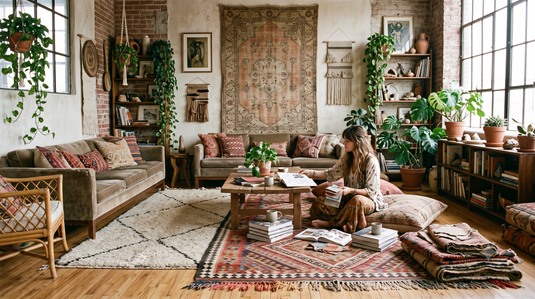
A rug can do more than fill an empty part of the floor. It can connect furniture, introduce colour, reveal a craft technique or preserve a personal memory. That is what makes a rug story useful in room design: the textile has a clear relationship with the people and space around it.
Boho rugs and carpet art offer different ways to create that relationship. Both can be expressive, but neither needs a room overloaded with pattern or a seller's elaborate narrative. This guide explains how to choose a rug with visual character and credible information, particularly when shopping online for a cozy living room.
What do we mean by a rug story?
Here, rug story means the meaningful connection between a rug's design, making, ownership and placement. It is not a recommendation or assessment of a retailer with a similar name. If you are researching a specific brand, its current products and policies need a separate item-by-item evaluation.
A story might come from documented weaving traditions, the maker's design process or your reason for choosing the piece. It might also be personal: a colour that reminds you of a place, a textile inherited from family, or a pattern that connects your room's existing art. The story does not have to be ancient to be meaningful.
Separate documented facts from interpretation. A seller may describe where and how a rug was made, while you decide what it means in your room. That distinction lets the rug be expressive without relying on unsupported claims about symbols, communities or the lives of unnamed artisans.
What makes rug stories stand out when shopping online?
Useful storytelling helps explain the product rather than distracting from missing specifications. Look for clear information about construction, material, dimensions and care, accompanied by photographs that show the textile honestly. A good narrative should make those details easier to understand.
Item-specific information is more valuable than a generic paragraph about centuries of craft. Ask what is known about this design, maker or production process. If a story claims a particular origin or age, look for evidence that relates to the actual piece. An evocative collection name is not provenance.
A convincing online presentation also shows the rug in ways that help you decide: overall pattern, close-up texture, back, edges and a sense of scale. Styled room images can be useful, but they should not replace these views. You need enough practical information to know whether the rug belongs in your daily life.
What distinguishes boho rugs from other styles?
Boho describes a broad decorating approach rather than one fibre or weaving method. Rugs used in that approach often introduce a relaxed mixture of pattern, texture and colour. Geometric motifs, flatwoven surfaces, fringe and an intentionally layered room can contribute to the effect, but none is compulsory.
A boho rug might be restrained and neutral or richly colourful. It may be handmade or machine-made, depending on the actual product. Do not infer authenticity, origin or durability from the style label. Treat those as separate questions that deserve specific answers.
The useful distinction is how the rug participates in the room. It can bring an informal, collected feeling rather than a rigidly matched scheme. That still benefits from careful editing. A rug with character is easier to appreciate when nearby furniture and accessories give it enough visual space.
Choose a boho direction that suits your room
Decide whether your room needs colour, texture or pattern most. If the sofa, curtains and artwork are already busy, a quieter textured rug may be enough. If the furniture is simple and neutral, a stronger patterned rug can provide the missing focal point.
Choose a limited set of connecting colours. They do not have to match exactly, but they should have a clear relationship with the floor and upholstery. A warm earth-toned rug can work beside timber, while a cooler pattern may support an existing blue or grey palette. Test the sample in the actual room.
Browse tribal-style rug designs and textured rugs with those priorities in mind. Collection names describe a browsing direction, not proof of a particular community's origin. Ask for the individual item's construction and source information where that matters to you.
How to avoid a room that feels overfilled
A collected look still needs organisation. Let one or two elements carry the strongest pattern and give the rest a supportive role. If the rug is expressive, use furniture shapes and larger surfaces to establish calm. A restrained sofa or wall colour can make a patterned rug more visible.
Layering can add texture, but it also adds practical questions. Check whether both rugs lie securely, whether the upper rug moves and whether their combined height interferes with doors or walking routes. A layered photograph may look attractive while representing an awkward arrangement for everyday use.
You do not need several rugs to create a boho room. One well-sized piece, chosen with a clear palette and appropriate texture, can be enough. Add personal accessories gradually rather than buying a large collection of objects simply to satisfy a style label.
What makes carpet art different from a regular rug design?
Carpet art places special emphasis on the textile's visual composition, concept or expression. It may use a pictorial image, an abstract arrangement, unusual texture or a deliberate relationship with the surrounding architecture. The term does not establish one construction method or a universally recognised quality standard.
A functional floor rug can also be artful. The difference often lies in how the piece is conceived and displayed rather than whether it is allowed to be walked on. Ask whether the maker recommends floor use, wall display or another setting. An expressive textile may still have practical limits.
Look at composition from the intended viewing distance. A piece designed to be read across a room may have a different effect when most of it sits beneath furniture. Decide whether you want the rug to support the seating group or function as a clearly visible artwork before choosing the size and placement.
Which materials work well for carpet art?
Wool can support texture, colour and a tactile floor surface when the construction suits use. Cotton can contribute to flatwoven or other textile structures. Silk and other decorative fibres can create particular visual effects, but they may need more careful handling and cleaning. Material choice should serve both the design and the intended location.
The foundation and supporting components matter alongside the visible fibre. A sculptural or highly textured surface may be impressive, yet less convenient beneath dining chairs or in a busy walking route. Ask how the textile is made and which areas should be protected from pressure or repeated abrasion.
There is no one best material for all carpet art. A wall piece and a family-room rug have different requirements. Compare the whole specification, care instructions and display recommendation. Our kilim and handloom guide explains how structure contributes to the textile's character.
Carpet art, tapestry and wall display
Tapestry is a specific woven textile tradition, not a synonym for every rug hung on a wall. The V&A's explanation of tapestry describes how a woven image can be created through the relationship of warp and weft. That offers context for appreciating textile art without merging all methods into one category.
If you plan to display a rug vertically, consider its weight, structure and condition. A hanging method should support the textile appropriately rather than concentrate stress in a few points. Ask the maker or a qualified textile professional what is suitable for the piece and the wall.
Do not assume that a floor rug can be fixed with nails through its corners. Some textiles need a carefully distributed support or another display method. A valuable or fragile piece may deserve a conservation-informed approach. The desired visual effect should not come at the expense of the textile's stability.
How to choose a rug that fits the space and tells a story
Begin with the furniture arrangement. Measure the seating group and tape the intended rug outline on the floor. The story will be easier to appreciate if the rug feels connected to the room rather than undersized or squeezed between doors and furniture.
Next, identify the visual relationship you want. The rug might echo an artwork, introduce a colour you love or soften modern furniture with a more tactile pattern. Write that intention in one sentence. It becomes a useful test when several attractive products compete for attention.
Finally, assess practical use. A delicate textile may express the perfect visual idea yet belong on a wall or in a quieter room. A more robust rug might communicate the same palette and craft interest while supporting daily living. Good room design includes knowing where a particular piece can be enjoyed responsibly.
Make the rug part of a cozy living room
Cozy does not require an exceptionally deep pile. A stable rug that connects the seating group, provides a pleasant underfoot feel and works with evening lighting can create comfort with a relatively restrained surface. The appropriate pad and furniture arrangement contribute to that effect.
Think about where people sit, put down drinks or play on the floor. Leave enough room for normal movement and choose a construction whose care requirements fit those activities. A rug that feels precious to the point of constant worry may be less comfortable to live with than a simpler piece.
Consider living room rugs in a range of visual styles. Compare an expressive boho pattern with a quieter modern rug using the same room measurements. The more convincing choice is the one that supports both the room's atmosphere and its everyday use.
Questions to ask an online seller
Ask for the exact material composition, method of manufacture, dimensions, care instructions and intended use. Request photographs of the back and edges where construction or condition matters. If the rug is handmade, ask what variation should be expected between the photographed example and the piece you receive.
For a story about origin or makers, ask which information is documented and how specific it is to the product. An honest answer may be limited, and that is preferable to an elaborate unsupported narrative. You can still appreciate an attractive rug whose history is modestly described.
Confirm current delivery and return arrangements before ordering. A compelling story should not distract from practical terms. If colour, dimensions or a handmade variation turns out to be different from what you expected, you need to understand which options are available.
Respectful storytelling and cultural references
Traditional designs can carry rich histories, but avoid assuming that one motif has a fixed meaning everywhere. Meanings may vary across time, place and individual makers. If a seller presents an interpretation, ask whether it comes from a reliable source or is simply a design description.
A design inspired by a tradition should be labelled as such when that is what it is. Inspiration and documented origin are different. Clear language allows both contemporary adaptations and traditional textiles to be appreciated without misrepresenting their backgrounds.
You can build a personal story around the rug without claiming knowledge you do not have. Explain why its colours, geometry or texture matter to you. That kind of honest connection often gives the room more character than repeating a symbolic explanation copied from an uncertain listing.
Care protects the story as well as the surface
Choose a care routine based on the fibre, construction and condition. Remove dry soil using compatible equipment, inspect the edges and respond promptly to spills. Avoid universal cleaning recipes, especially where the piece contains several materials or sensitive dyes.
If the rug has sentimental value, document its condition and retain the seller's care information. A photograph and a short record of its origin or purchase can be useful later, particularly if the textile moves between homes. Store the information alongside any professional cleaning or repair notes.
Seek advice before extensive treatment of a valuable or fragile piece. Preservation may matter more than removing every trace of use. The aim is to keep the textile stable and meaningful rather than force it to look newly manufactured at all costs.
Three different ways to create a rug story
In a modern neutral living room, a geometric flatweave can provide colour and a clear craft reference. Its story may be the technique and the way it connects existing artwork. Keep the supporting furniture quiet enough for the pattern to be appreciated.
In a room with inherited furniture, a restrained wool rug can connect old and new without imitating the furniture's period. Its story might be your choice to make the room comfortable for the next generation. A highly ornate design is not required for that connection to be meaningful.
In a small apartment, a textile used as a considered wall piece may communicate the design more effectively than placing it beneath crowded furniture. Confirm appropriate support and display conditions. The story comes from the relationship between the textile and the room, not from insisting that every rug must be on the floor.
Choose meaning, evidence and practical fit together
A strong rug story combines something you can see, something you can understand and a reason the piece belongs in your space. Boho style can provide relaxed pattern and texture. Carpet art can provide an expressive composition. Either becomes more convincing when the product information is clear and the placement is thoughtful.
Before buying, return to your room measurements, colour test, specification and care plan. If those align with the story you want to tell, the rug is more likely to remain satisfying after the room has been photographed. A personal, well-chosen textile can make a living room feel coherent without relying on exaggerated provenance or unnecessary decoration.
Rug materials that balance durability, comfort and a good story
A meaningful rug story becomes more convincing when the textile works in the room. For a frequently used living space, begin with a well-constructed wool rug if a natural tactile surface is important, then compare other options against its actual care requirements and construction. Handwork or a compelling narrative should not excuse weak edges or unsuitable placement.
A wool flatweave can communicate its technique through visible structure and graphic colour areas. A wool pile rug can provide a different underfoot feel. A suitable pad may improve comfort and stability, but it should be chosen for the rug and floor together. Neither thick pile nor fine knotting alone establishes the best everyday value.
Cotton can suit a relaxed woven design or a lighter room where its stability and care instructions fit use. A synthetic rug can offer a convincing colour composition and practical specifications without an invented heritage story. You can value its design honestly. It does not need to be described as a traditional handmade textile to belong in a personal interior.
Silk and lustrous regenerated fibres may create particular effects in carpet art or a quieter decorative room. They can also make cleaning and placement more demanding. Keep those materials where their vulnerabilities are compatible with daily life, rather than putting a delicate surface in the busiest route because its narrative is attractive.
Natural plant fibres add another kind of texture, but jute and sisal are distinct materials. Their moisture and comfort characteristics need individual assessment. If people frequently sit on the floor or pets have accidents, a coarse or water-sensitive surface may be less suitable than its visual simplicity suggests.
The story can be documented craft, a design decision or your own connection with the colours. Request item-specific origin and production information when those claims matter. Then test size, feel, maintenance and the seller's terms. A rug with honest information and a clear role in your home tells a stronger story than a delicate or undersized piece supported by exaggerated claims.