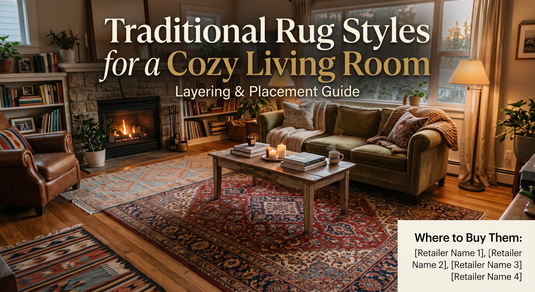
A traditional rug can make a living room feel warmer without turning it into a formal period interior. The best style depends on the mood you want: an all-over floral pattern for gentle richness, a medallion for a clear centre, a geometric tribal-style rug for relaxed character, or a muted classical design for a quieter room.
For authentic handmade options, begin with The Ambiente's traditional collection and compare relevant pieces from Jaipur Rugs, Obeetee, Hands and Carpet Cellar. This guide is published by The Ambiente, so our own catalogue appears first. Authenticity should be checked through the actual product's construction, origin and documentation, not inferred from a traditional-looking pattern.
Decide what cozy means in your room
Cozy can describe softness underfoot, a warmer colour scheme, a more connected seating arrangement or a relaxed atmosphere. Those are different goals. A thick rug may address touch, while a flatter patterned rug can make a seating group feel more inviting through colour and scale.
Look at the room you already have. If the sofa is plain and the walls are quiet, a more detailed rug may provide the missing interest. If curtains, upholstery and artwork already carry strong patterns, a subdued traditional design may be easier to live with.
Also consider the room's daily use. A carpet that requires careful professional cleaning may suit a quiet sitting room better than a place where children eat and pets rest. Comfort includes being able to use the room without worrying about every ordinary activity.
All-over floral rugs for gentle richness
An all-over floral pattern distributes interest across the surface. This can be useful beneath a coffee table or an asymmetric seating group because the rug does not depend on one central motif remaining visible.
Choose the pattern scale carefully. Small, dense motifs can read almost like texture from a distance. Larger flowers create a clearer statement. Ask for a full view at the actual rug proportions so you understand the effect beyond a close-up.
Explore The Ambiente's floral rugs and traditional rugs. Compare the individual materials and constructions, then decide whether a warm, muted or contrasting palette works with your furniture.
Medallion rugs for a composed seating group
A central medallion gives the rug a focal point. It can work well with balanced seating and a room that has a clear central axis. The surrounding border and field help organise the arrangement visually.
Check what the coffee table will cover. If it hides the centre entirely, you may be paying for a feature you rarely see. A glass-topped table can reveal more of the design, but the table base and stored objects still affect visibility.
You do not have to place every chair symmetrically to use a medallion rug. However, it helps to view the full pattern beside a simple room plan. Consider whether the design supports the layout or makes an otherwise relaxed room feel unnecessarily rigid.
Geometric tribal-style rugs for relaxed character
Angular motifs and repeating geometric patterns can bring warmth without delicate floral detail. They often pair well with plain upholstery, natural wood and a limited palette of cushions.
Use the term tribal style accurately. A pattern inspired by a weaving tradition is not necessarily an older tribal-made rug. If origin matters to your purchase, ask where the rug was made, how it was constructed and whether it is newly produced.
The Ambiente's tribal collection is a browsing starting point. Evaluate the selected product's description rather than assuming that a collection label provides provenance for every item.
Muted traditional and transitional rugs for quieter interiors
A faded or restrained palette can soften the visual weight of a detailed design. This is useful when you like classical motifs but want the room to feel contemporary and relaxed.
Distinguish a deliberately distressed new design from natural wear in an older carpet. They can produce a similar visual impression, but the purchasing questions differ. A vintage item needs condition information; a newly made rug needs an accurate specification.
Compare transitional rugs and vintage-style options with traditional designs. Choose the actual product based on its stated construction and condition, not an assumed age from the collection name.
Flat-woven traditional patterns for an informal room
A flat weave can offer pattern without a deep pile. It may suit a room where easy furniture movement and a lower profile matter. Add suitable cushioning beneath it if the manufacturer recommends an underlay and the floor is compatible.
Flat-woven does not mean maintenance-free. Fibre, finishing, fringe and dye behaviour still need attention. Ask how the rug should be cleaned and whether the supplier recommends it for your household's use.
Explore flat-weave rugs if the room needs a quieter surface. The tactile effect will differ from a plush carpet, so consider whether your idea of cozy is about softness, colour or the arrangement of furniture.
A style comparison for your shortlist
| Style | Visual effect | Layout question |
|---|---|---|
| All-over floral | Richness distributed across the rug | Will furniture leave enough pattern visible? |
| Central medallion | Clear focal point | Will the centre be covered by the table? |
| Geometric tribal style | Relaxed pattern and character | Does the scale work with nearby textiles? |
| Muted classical | Gentle detail with less contrast | Are the colours visible in your lighting? |
| Traditional flat weave | Informal pattern with a lower profile | Do you need extra cushioning or grip? |
Use the table to choose a direction before comparing suppliers. It is easier to assess five rugs that solve the same design problem than five unrelated carpets that happen to be attractive.
Where to buy and what to ask
The Ambiente
Start with the relevant collection, then shortlist two or three rugs in the intended dimensions. Ask for ordinary-light photographs and a close look at the reverse and edges if you are buying handmade construction.
Explain whether the room is formal, family-oriented or used with pets. Ask for the chosen product's cleaning instructions before deciding. The conversation should connect the rug to your needs rather than rely on a general statement that it suits living rooms.
Jaipur Rugs
Jaipur Rugs is another catalogue to investigate. Use the regional site and check the actual material, construction and stock information for the chosen rug.
If the intended size is not available, ask about alternatives and timing. Do not assume that a different size shown online can be stretched or adapted to your room without affecting the pattern.
Obeetee and Hands
Obeetee and Hands offer additional product-led comparisons. Match the construction and dimensions to your shortlist before comparing prices.
For each rug, save the care instructions and full pattern image. If a page leaves a material detail unclear, ask for clarification. Do not infer silk, wool or hand knotting from a decorative photograph alone.
Carpet Cellar for specialist or older pieces
Carpet Cellar is worth exploring when your brief includes an older rug or a specialist traditional design. Ask whether the chosen carpet is newly made, vintage or antique.
For older pieces, request close photographs of wear, repairs and the foundation. Discuss whether the item suits everyday family use. Decorative appeal and condition are separate parts of the decision.
What authentic means when buying a traditional rug
Authentic should refer to a stated claim that can be supported. A rug may be genuinely hand-knotted, genuinely made in a named region or genuinely of a documented age. These are different claims and require different evidence.
A newly made Indian rug with Persian-inspired motifs is not misleading if described accurately. Problems arise when inspiration is presented as origin or a new distressed surface is presented as proof of age.
Read our guide to identifying a genuine handmade rug. Request a clear description, photographs and relevant documentation. A visible fringe, an irregular line or a high price is not sufficient proof on its own.
Choose a material for daily comfort
Wool is a useful option to investigate for a living room because it can provide a tactile surface and a less reflective appearance. The actual product's quality and suitability depend on more than the fibre name, so inspect construction and care too.
Lustrous accents can add depth to a classical pattern, but they may show directional shading and require different cleaning. Ask the supplier to identify the fibres clearly. Natural silk and bamboo silk should not be treated as interchangeable descriptions.
If you need a straightforward daily routine, prioritise the product whose maintenance you understand. Our material comparison can help frame the choice, but the manufacturer's instructions for the chosen rug take precedence.
Use warm colours without making the room heavy
Warm red, rust, brown and muted gold can connect with wood furniture and create a welcoming effect. Blue and green can also feel cozy when balanced with warm lighting and tactile upholstery.
Choose one or two links to the room's existing palette. A rug might repeat the cushion colour or introduce a related shade from the artwork. You do not need to match every furnishing exactly.
Check the design in your actual lighting. A subtle pattern that looks clear in bright studio photography may be difficult to see in a dim living room. Request a daylight video and consider a sample if available.
Size the rug around the seating area
A generous rug can connect a sofa and chairs into one group. A smaller rug floating between them may leave the room feeling fragmented. Measure the seating footprint and decide where furniture legs should sit.
The front-legs-on arrangement is a useful starting point, not a universal rule. A large room may allow all furniture legs on the rug; a compact room may call for another solution. Preserve comfortable walking routes and access to doors.
Use the complete size guide and tape out the dimensions. Then check how much of the border and field will remain visible. This combines practical fitting with the pattern decision.
Layer the room without competing patterns
If the rug is detailed, keep some nearby fabrics plain. A textured throw, simple cushions and warm light can create depth without another large motif. Repeating too many unrelated patterns can make the room busy rather than inviting.
If the rug is muted, you can add more personality through cushions or artwork. Use a shared colour to connect them. The rug should support the room's composition, not carry every decorative idea at once.
Also consider the furniture finish. A dark wood table over a deep red rug creates a different balance from pale wood over an ivory floral carpet. Review the whole palette before selecting the final colour variation.
Plan for pets, spills and cleaning
If your living room is busy, ask about pile structure, fringe and stain treatment. A delicate decorative rug may be appropriate in one household and impractical in another. Be honest about the daily routine rather than assuming you will suddenly change it after purchase.
Use a suitable pad, keep the floor clean and follow the cleaning label. Address spills promptly with the product-specific method. Avoid applying a generic online recipe to silk, bamboo silk or an older rug with uncertain dye behaviour.
For additional planning, read rug materials for high-traffic areas and pets. The guide can help you formulate questions, but it does not replace the selected product's care advice.
A cozy-room example
Imagine a small living room with a beige sofa, warm wood furniture and an off-white wall. An all-over muted floral rug could add interest without creating a strong central axis. A geometric rug in rust and ivory could produce a more relaxed effect.
Tape out the same size for both options. Compare the full pattern beside your room photograph, then assess fibre and maintenance. This makes the choice about the room rather than whichever product image initially caught your attention.
Frequently asked questions
Which traditional style is the coziest?
There is no single answer. All-over floral, geometric and muted classical designs can all feel inviting when their scale and colours suit the room.
Is an authentic rug always expensive?
Authenticity describes supported claims about the product, not a minimum price. Construction, size, material, condition and provenance influence cost.
Can traditional rugs work with a modern sofa?
Yes. A simple sofa can let the rug's detail stand out. Connect the palette and avoid too many competing motifs.
Should I buy a vintage rug for everyday use?
Ask for a condition assessment and the dealer's care advice. Age alone does not tell you whether a particular carpet suits your household.
Find the right balance
Choose a style that supports the seating arrangement, a material you can maintain and a seller who can explain the actual product. A cozy living room comes from those choices working together, rather than from one particular historical pattern.
Retailer references were checked on 3 October 2026. Confirm the current details of the exact carpet before ordering.