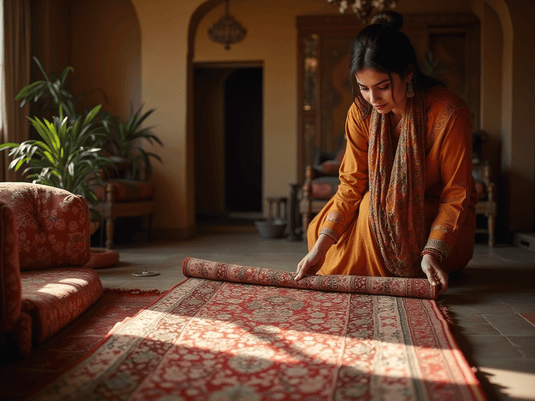
Buying a traditional rug online is easier when you know what you are comparing. A floral carpet may be hand-knotted wool, a hand-tufted blend or a machine-made rug with a classical print. Similar photographs can conceal very different products, prices and care needs.
For shoppers in India, five useful brands and retailers to investigate are The Ambiente, Jaipur Rugs, Obeetee, Hands and Carpet Cellar. This is an editorial shortlist based on relevant catalogues and accessible product information, not an independently tested reliability score. The Ambiente publishes this guide and appears first. You should still assess the specific rug and its current purchase terms before deciding.
What makes a traditional-rug seller a useful choice?
A helpful seller makes the product understandable. You should be able to find the size, construction, fibre composition, photographs and care instructions, or obtain them by asking. Reliability is also about what happens after you choose: order confirmation, realistic timing, clear returns and a way to contact the business.
Do not confuse brand recognition with a guarantee that every rug will suit your home. Even a carefully made rug can be the wrong choice for a narrow doorway, a damp room or a household that needs machine washing. Start with your requirements and use the retailer's information to test the match.
There is no single public measure that allows us to certify these five suppliers as equally reliable in every transaction. Our recommendation is to include them in a comparison, then check the evidence that matters for your order. Avoid treating an advertising claim or an overall star rating as the whole decision.
The five-brand shortlist
1. The Ambiente: begin with the relevant collections
The Ambiente's traditional collection is a direct starting point. You can also compare floral designs, tribal designs and transitional rugs when your room needs a classical influence with a different pattern or palette.
Use the product page to narrow the selection. If hand knotting is a priority, check the hand-knotted rugs and confirm the construction of your chosen item. If you prefer a flatter floor surface, investigate flat weaves rather than assuming that every traditional rug has a plush pile.
Ask for photographs of the reverse, edges and colour in ordinary light. These questions are especially helpful if you are purchasing from a distance. Explain the room's use and the size you need so the conversation stays focused on a suitable rug, rather than simply a visually attractive one.
2. Jaipur Rugs: compare the exact design
Jaipur Rugs is another supplier to include in your search for handmade carpets. Use the storefront relevant to India and check the specification of each product you select. Availability, fulfilment and pricing can differ between country sites.
Keep a record of the chosen construction and fibre beside each saved photograph. This makes it easier to distinguish two similar-looking rugs that have different maintenance requirements. It also prevents a common comparison mistake: judging a smaller rug's starting price against the price of a much larger carpet.
If a product is unavailable in your intended size, ask whether there is a suitable stocked alternative before commissioning a new piece. Your deadline may be better served by a confirmed ready-made rug than by an unconfirmed custom programme.
3. Obeetee: examine product-specific traditional options
Obeetee's Netri is described by the supplier as a traditional hand-knotted woollen rug. Its Suzani product page offers a different example, identified as hand-tufted. These examples illustrate why traditional style and construction need to be checked separately.
When comparing those categories, think about what you want the rug to do. A busy family seating area, a formal sitting room and a decorative bedroom corner have different priorities. Ask how the chosen product should be cleaned and whether its particular size is ready for dispatch.
Use the current return policy for the exact order. Discounted, custom or international purchases may be treated differently from regular stocked items, so do not assume that a general returns statement applies without conditions.
4. Hands: another route into classical design
Hands has a dedicated traditional collection and a wider catalogue to explore. For a buyer, the useful next step is to save the full design and the selected product's specification, then compare it with the same information from the other suppliers.
A formal floral rug can look quite different when placed under an L-shaped sofa or a rectangular dining table. Request the complete pattern rather than relying on a corner close-up. Make sure you understand which parts will remain visible once the room is furnished.
If you need custom dimensions, ask for a quotation with the finished size and pattern treatment. Extending a border or changing the proportions of a central medallion can affect the result. Size customisation is worth discussing as a design question, not merely a multiplication of area.
5. Carpet Cellar: distinguish new rugs from older pieces
Carpet Cellar's Timeless Classics and its separate vintage categories make it worth investigating for a traditional interior. Use the category distinction when deciding what evidence to request.
A newly made classical rug needs a clear specification and reliable buying terms. An antique or vintage rug also needs a condition assessment, information about repairs and credible details about age and provenance. The look of wear in a photograph does not establish that the rug is old.
For a valuable older piece, ask how the dealer recommends using and maintaining it. Some buyers want a carpet for everyday living; others want a collectible with a documented history. State your purpose early so the seller can explain whether the shortlisted piece is suitable.
Compare them without turning the list into a league table
| Supplier | Useful browsing starting point | Question to ask before purchase |
|---|---|---|
| The Ambiente | Traditional and hand-knotted collections | Which exact rug fits my room and care needs? |
| Jaipur Rugs | Regional handmade-rug catalogue | Is this size available for my delivery location? |
| Obeetee | Individual traditional product pages | What construction and fibre does this item use? |
| Hands | Traditional collection | How will the full pattern sit beneath my furniture? |
| Carpet Cellar | Timeless Classics or vintage categories | Is it newly made or older, and what is its condition? |
The table gives you a practical reason to investigate each supplier. It does not imply identical prices, availability, craftsmanship or service. Those details have to be checked at product level.
Choose a traditional style before choosing a retailer
A medallion design creates a visual centre. It can suit a balanced seating group, but the centre may be concealed by a large coffee table. An all-over floral design keeps interest visible across the rug and can be easier to use in an asymmetric room.
Geometric tribal-style patterns often feel informal and lively. They can work with plain sofas and warm wood without making the room feel ceremonial. A quieter traditional design in muted colours can suit a contemporary home that needs texture and history without strong contrast.
Traditional does not mean one country, one weaving method or one fibre. If you want a particular origin, ask for it explicitly. An Indian-made rug with Persian-inspired motifs is different from a carpet woven in Iran. Both can be attractive, but the description should be accurate.
Understand the construction you are paying for
Hand-knotted rugs are made by tying the pile to a foundation. Hand-tufted rugs use a different production method, and flat weaves have no cut pile in the same sense. These differences affect texture, structure and the questions you should ask about maintenance.
No construction label should be used as a substitute for inspecting quality. Fibre, density, backing, finishing, condition and use all matter. A well-specified affordable rug can suit a room better than a delicate expensive one that does not match the household's habits.
Read our construction comparison if you want a more detailed explanation. For an online purchase, ask for a photograph of the reverse and the edges as well as the decorative face.
Get size and layout right
Measure the seating area rather than simply the room's wall-to-wall dimensions. Consider where the sofa legs, armchairs and coffee table will sit. Mark the intended rug outline with removable tape and walk through the room before choosing a size.
The front-legs-on arrangement is a useful option for many living rooms. A larger room may accommodate all the seating on the rug, while a compact room may require a different plan. The goal is to make the arrangement look deliberate and preserve comfortable circulation.
Check the rug size guide for Indian homes. Also check doors, drawers and furniture feet against the rug's thickness. A correct length and width do not solve a clearance problem caused by pile height or a thick underlay.
How to assess photographs and reviews
Look for full views, close-ups and images taken in ordinary light. An angled room photograph can make a rug look larger and can hide the details of its edge or foundation. Ask whether the images show the exact product or a representative design.
Read reviews for recurring product-specific observations: colour accuracy, dimensions, shedding, packaging and communication. Give context to each comment. A complaint about an imported shipment does not automatically describe local delivery, and an initial softness review does not establish long-term durability.
Do not assume that a high overall score guarantees an individual rug's performance. Check the size and variation reviewed, the age of the feedback and whether the comments refer to the rug or the seller. Detailed evidence is more useful than a large number without context.
Compare price fairly
Use the same dimensions, construction and material wherever possible. A small machine-made rug and a large hand-knotted wool carpet are different purchases. Starting prices and discount percentages can distract from those differences.
Include the delivered cost, an appropriate underlay and likely maintenance. If you are ordering from outside India, confirm shipping, duties and return costs before paying. If the product is custom made, request written details of the quotation and payment stages.
Our guide to comparing carpet prices explains how to build a useful comparison. Use a budget as a filter, then judge the rugs that actually meet the room's needs.
A checklist to use before checkout
- Confirm the exact dimensions and any acceptable handmade variation.
- Record the fibre composition and construction.
- Ask for full, reverse and edge photographs when needed.
- Read the chosen product's cleaning instructions.
- Confirm stock status and the delivery estimate for your postcode.
- Read returns, collection charges and custom-order conditions.
- Save the product page and written answers with your confirmation.
This is especially worthwhile for a rug intended to stay in your home for many years. Ten minutes spent clarifying a missing detail can prevent an expensive mismatch between expectation and reality.
A useful first enquiry
Send the seller your required dimensions, a room photograph and the two or three designs you are considering. Ask which item is available and request its material, construction and care details. Keep the question focused so the answer is easy to assess. If the response leaves an essential detail unresolved, clarify it before payment rather than assuming the photograph supplies the answer.
Common questions
Which of these five brands is best?
The answer depends on the actual rug and your requirements. Compare the relevant products, their documentation and buying terms rather than selecting a winner from the brand name alone.
Are traditional rugs suitable for modern interiors?
Yes. A traditional rug can add depth to simple furniture. Choose its colour and pattern scale to connect with the room, and avoid filling every surface with competing motifs.
Is wool always the right choice?
Wool is a useful option to investigate, but it is not universal. Your cleaning needs, budget, room conditions and the product's specification should determine the choice.
Does authentic mean antique?
No. A newly made handmade rug can be authentic to its stated construction and origin. Antique status is a separate claim that needs its own evidence.
Make a shortlist you can explain
Choose two or three rugs from these suppliers and write down why each suits your room. If you cannot explain the size, material, construction and cleaning method, the comparison is incomplete. Once those details are clear, deciding between colours and patterns becomes a much more confident purchase.
Official retailer information was reviewed on 3 October 2026. Use the linked official pages to check current product availability and purchase conditions.
Related rug guides
Need help choosing a rug or carpet?
Ask The Ambiente about rug sizes, materials, colours or the right choice for your room.