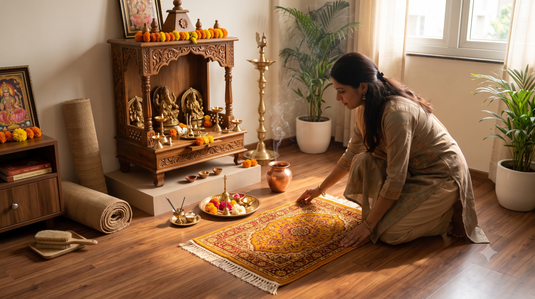
A rug in a puja room has a practical job before it has a decorative one. It provides a defined place to sit, kneel or gather, and it needs to work with the way the room is used every day. A family that performs a brief morning puja has different needs from a household that gathers several people for longer ceremonies. The rug should support those routines while remaining easy to inspect, maintain and move when the floor needs cleaning.
Start with your family's practices rather than a universal colour or pattern rule. Some households prefer a plain seating surface, while others use a border or floral design to mark the area. A floor rug is not the same object as a ceremonial textile placed on an altar, and religious traditions differ. This guide focuses on the floor seating area in a home puja room, without presenting a particular rug as spiritually necessary or promising a change in prosperity.
Map the activities before measuring the rug
Make a simple list of what happens in the space. Note where people sit, where offerings are prepared, where utensils are placed and which areas need to remain clear. Include the position of the mandir, its cabinet doors and any regular movement between the entrance and seating. If the room is also used for quiet reading or meditation, include that layout as a separate use rather than assuming that one arrangement serves everything.
Check the full routine with the furniture and storage in place. A rug may look correctly sized in an empty room but become awkward when a low stool or a tray is added. Watch where feet land when someone stands up and whether the rug edge sits directly in that movement. A stable, level transition is more important than placing the rug exactly at the visual centre of the room.
If visitors join for festivals, decide whether the everyday rug will remain suitable or whether temporary seating will be added. Avoid buying an oversized rug solely for one annual gathering if it makes the room difficult to use during the rest of the year. A flexible arrangement can keep the main rug in its intended position while leaving a clear area for additional seating.
Measure the seating area, not the entire room
Record the usable floor between the mandir and the entrance, including the narrowest walkway. Then measure the actual seating footprint. Sit in the position you normally use and allow room for legs and any cushion. For more than one person, test the arrangement physically. There is no fixed rug dimension that suits every puja room, because furniture depth, body position and the number of users vary.
For example, a 120 by 180 cm outline may be a useful trial for a compact seating area, but it should not be treated as a standard recommendation. Mark the boundary with removable tape and use the room normally. Check whether the outline leaves cabinet doors clear, whether someone can stand without stepping across an awkward edge and whether another person can pass behind the seating area.
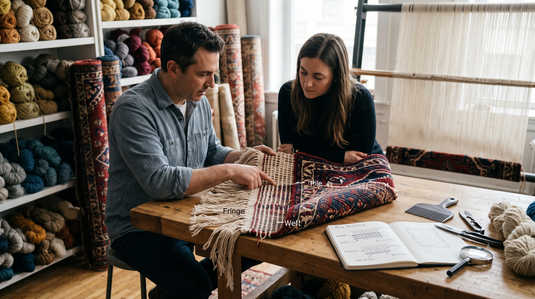
Confirm whether the retailer's listed dimensions include fringe. Fringe can extend into a path even when the main rectangle fits. If you are considering a handmade rug, ask about the expected size tolerance. A layout that depends on a few centimetres of clearance may need more room. Our guide to measuring a custom rug explains how to turn an outline into an accurate enquiry.
Choose shape around circulation and furniture
A rectangle usually offers predictable seating space and a clear relationship with a straight mandir or cabinet. A small square can suit a compact individual area, while a round rug can create a softer boundary in a larger room. The shape should still accommodate the way people sit. A circle with the same maximum width as a rectangle provides less usable area near its outer edges.
Avoid irregular projections in the main route to the door. A freeform rug can look attractive, but narrow sections may be harder to secure and can make the seating boundary less predictable. If you want an unusual shape, request a measured outline and test it on the floor. The design should remain practical when cushions and stools are in use, not only when the room is photographed empty.
For round options, browse round rugs and verify individual dimensions and construction. For a smaller room, consider whether a regular shape would simplify pad fitting and routine cleaning. The right answer comes from the measured layout rather than a general belief that one shape is always more appropriate for a sacred space.
Compare comfort and support together
A soft surface can make floor seating more pleasant, but very deep pile is not the only way to achieve comfort. A rug, suitable pad and separate seating cushion can provide different layers of support. Consider how easy it is to stand up, whether small stools remain level and whether the rug edge creates a noticeable change in height. The whole arrangement matters more than the softness of one sample held in the hand.
If a family member prefers a chair, include that chair in the plan. Its feet need stable support, and its position should not narrow the entrance route. Avoid placing only one or two chair feet on a thick rug if that makes it tilt or rock. A puja room can accommodate different seating preferences without forcing everyone into the same floor position.
Evaluate comfort over the length of a normal session. A rug that feels appealing for a moment may be less practical if its pile compresses unevenly or makes utensils unstable. Keep trays and vessels on surfaces intended to support them, rather than assuming a plush rug will provide a flat platform. The rug's role is seating and visual definition, not replacing every other functional surface.
Look at fibre, pile and backing separately
Wool is one possible material for a comfortable floor surface, but wool rugs vary by construction, pile and blend. A lower-profile weave may be easier to maintain than a deep pile in some rooms. A blend containing a more delicate fibre may require different spill care from a pure wool product. Ask for percentages and written cleaning instructions rather than relying on a description such as premium or silky soft.
Flatweaves can offer an even surface and manageable thickness, depending on the individual product. They may need an appropriate pad to reduce movement on smooth flooring. Some are reversible, but that is not universal, and reversibility does not mean dirt or moisture can be ignored by turning the rug over. Check the actual weave, edge finishing and care requirements.
Compare wool rugs and flat-weave rugs as browsing categories, then assess each shortlisted item. The collection name does not certify suitability for your particular religious routine, stain resistance or machine washing. Those are separate product-level questions that should be settled before purchase.
Keep lamps, incense and hot objects away from textiles
A seating rug should remain outside the working area for flames, hot vessels and incense. Use the appropriate stable, non-combustible support for those objects and follow the relevant product instructions for clearance. Do not put a diya, candle or hot container directly on the rug, even if a fibre is marketed with a favourable fire-related characteristic. A rug is not a heat shield or a fireproof surface.
Plan this separation in the layout rather than improvising during a ceremony. Check where a tray is carried and where it is set down. Keep loose fringe, cushions and other textiles away from the lamp area. If the room is too compact to maintain a sensible separation, reconsider the rug size or location. A decorative border is less important than having a clear place for the actual ritual objects.
Do not extend a floor rug beneath an altar solely to make the room look more unified if that would bring it closer to heat or make cleaning difficult. The mandir and seating area can remain visually connected through colour while serving different functions. A smaller, correctly placed rug is often more useful than a larger one that occupies every available surface.
Choose colour according to the whole room
The rug will sit beside the mandir material, walls, floor and lighting. Warm timber, brass, white marble and coloured stone can each influence how a neutral appears. A cream rug may look warmer against cool marble, while grey can look quite different under warm lamps. Request a sample where possible and place it on the actual floor rather than checking it only beside a product photograph.
If your family follows particular colour preferences, incorporate them as part of the design brief. There is no need to present those preferences as universal rules for every household. A restrained palette can help a detailed mandir remain the main visual focus, while a modest border can define the seating area. A strong pattern may work in a plain room, but it should not compete with several already intricate surfaces.
Think about visibility of everyday debris as well. Pale rugs can show flower fragments or certain spills, while dark rugs can show lint and dust. A varied pattern may make small changes less visually obvious, but it does not establish easier cleaning. Our rug colour guide explains how to assess undertones and contrast without relying on one colour name.
Select motifs thoughtfully
Floral, geometric and restrained traditional designs can all work in a puja room. Ask your household whether a motif has a specific meaning or whether a plain surface is preferred. Avoid choosing a design merely because a seller calls it spiritual. A floor surface may not be the appropriate place for imagery or text that your family treats with particular respect.
Distinguish a decorative contemporary motif from a documented historical or religious design. A temple-inspired description does not independently establish origin, authenticity or a spiritual effect. If craftsmanship matters, ask how the rug was made and what evidence supports the description. Our handmade rug identification guide provides a practical framework for those questions.
Plan for flowers, powders and everyday spills
Puja routines can introduce flower fragments, ash, oils, powders or water near the seating area. Reduce unnecessary exposure by keeping preparation and storage on suitable surfaces. Remove loose debris according to the rug's care instructions without rubbing it into the pile. Different substances need different treatment, so avoid applying one internet recipe to every mark.
For liquid, blot promptly with a clean absorbent cloth and check whether it has reached the backing, pad or floor. Follow the manufacturer's permitted treatment. Oils and strongly coloured powders may need specialist advice, especially on delicate fibres. Do not saturate the rug or use stronger chemicals simply because a mark remains visible. Keep the written care information accessible before a festival or family gathering.
Routine vacuuming should match the rug's construction. Be careful with fringe and loose edges, and check whether a rotating brush is allowed. For broader maintenance, read our guide to cleaning and protecting The Ambiente rugs. The individual product instructions take priority over general care advice.
Fit a pad suitable for the floor
A pad should be compatible with the rug backing and the actual floor finish. Smooth marble, sealed wood and tile can have different requirements. Ask the pad supplier rather than assuming that an improvised liner will behave safely. Keep the pad within the rug's boundary and assess the combined thickness when checking doors, stools and seating transitions.
Inspect the pad and floor periodically, especially after a spill or damp conditions. A dry-looking rug face does not prove that the underside is dry. Avoid leaving moisture trapped against the floor. Our rug pad guide explains the compatibility questions to ask before installation.
Purchase and installation checklist
Before ordering, record the seating footprint, shape, material percentages, construction, pile profile, backing and care method. Confirm current delivery and return conditions and ask about size variation. If the room needs a custom dimension, send a measured sketch and explain the cabinet and lamp clearances. Do not rely on a general puja-room label to establish a fit.
On delivery, inspect the rug in good light before arranging the room. Confirm the dimensions, check edges and backing and compare the item with the written specification. Install the pad, use the seating arrangement normally and recheck movement after several days. The most suitable puja-room rug respects the household's practices while providing a stable, comfortable surface that can be maintained throughout the year.