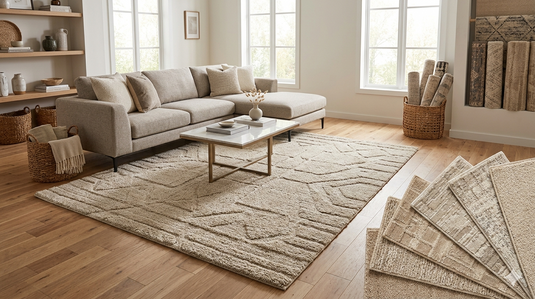
A beige rug can give a living room a quiet foundation, connect different furniture colours and leave room for artwork or patterned cushions. Choosing one well takes more than picking the lightest photograph. Warm sand, greyed taupe, pale cream and deeper tan can create quite different relationships with the sofa and floor. Size, texture and cleaning requirements matter just as much as the shade.
Begin with the furniture you intend to keep. Measure the seating group, look at the floor's undertone and decide how much pattern the room needs. Then compare a few beige rugs in the right footprint. This order helps you avoid a common mistake: buying an attractive neutral that is too small, too close to the floor colour or more demanding to maintain than expected.
The Ambiente's beige and tan rugs provide a starting point for comparing named designs, compositions and selected size variants. Read each listing carefully. A mixed-colour rug may contain beige as one part of the pattern rather than having a uniform beige background. Use the photographs, material description and actual dimensions together when making your shortlist.
Beige, cream, taupe and tan: identify the undertone
Beige is a family of colours rather than one precise shade. Some versions have a yellow or sandy warmth; others lean pink, grey or brown. Cream usually suggests a lighter warm direction, taupe often mixes brown and grey, and tan generally introduces a deeper earthy colour. Sellers use these words differently, so an actual sample is more informative than the name alone.
Place a sample beside the sofa, curtain and visible floor in the same view. A pale beige that looks neutral on a white screen may appear yellow beside cool grey upholstery. A greyed beige may look pleasantly restrained against oak and slightly dull beside a warm cream wall. These are relationships to test, not reasons to reject a shade before seeing it in the room.
If two neutrals almost match but feel uncomfortable together, try creating more deliberate separation. A slightly deeper rug, a mixed pattern or a different texture may work better than another nearly identical pale tone. You can also choose a connecting colour already present in a cushion or artwork. The aim is a coherent room, without needing every surface to share exactly the same beige.
Match a beige rug with a grey sofa
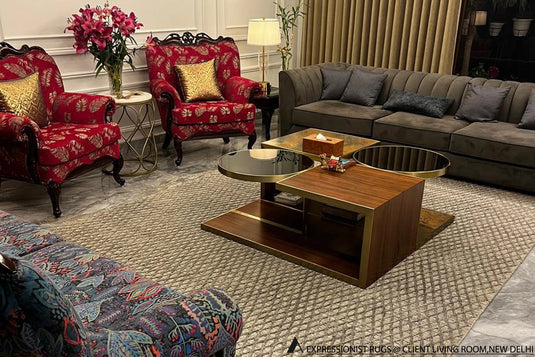
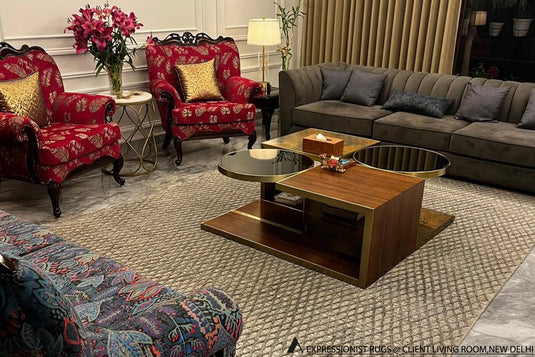
First identify the grey sofa's direction. Blue-grey and warm greige are different backgrounds. A greyed beige or taupe can create a restrained connection with cooler upholstery; warmer sand may suit a greige sofa. Neither is a fixed rule. The floor, wall paint and lamps can alter the combination, so assess those elements at the same time rather than comparing the sofa and rug in isolation.
For a pale grey sofa on dark timber, a light beige rug with modest charcoal detail can connect the upholstery and floor. The darker drawing provides a bridge while the lighter ground keeps the seating footprint visible. If the sofa is already patterned, compare a quieter rug. If the sofa is plain, a larger but restrained geometric or abstract design may supply useful interest.
For a deep charcoal sofa, check that enough difference in lightness remains between the seating and rug. A cream-and-taupe design can provide a softer contrast than pure white. Repeat one of its darker notes in a cushion or slim table frame if the room needs a connection. View the composition from the doorway, because the rug's relationship with the complete furniture group matters more than a close-up swatch.
Match beige rugs with cream, brown and colourful seating
With cream seating, compare the warm and cool pale tones carefully. A beige rug can work through subtle differences, but a barely distinguishable uniform surface may feel flat. Texture, a quiet border or a slightly deeper sand shade can introduce definition. Avoid choosing a lustrous material solely to create contrast until you have checked whether its maintenance requirements suit the household.
With brown leather or walnut furniture, beige can provide a lighter foundation. Test a sandy tone beside warm leather and a more greyed beige beside cooler brown upholstery. A rug containing brown details can connect the furniture without copying its whole colour. For deeper earthy options, our brown rug styling guide explains how floors, curtains and upholstery can work together.
With blue, green, rust or patterned seating, beige can give the main colour space to stand out. Check whether the rug includes a small connecting tone you already own. A neutral ground with restrained blue or green detail may be easier to coordinate than a completely separate pattern. Our living room rug colour guide helps when you are deciding how much colour the room should carry.
Consider the floor before choosing the shade
On warm wood, compare a beige that remains visibly distinct from the floor. Similar brownish values can blur the edge of the seating area even when both surfaces are attractive individually. A lighter ground or a pattern with a little darker drawing may create the separation you need. Leave some floor visible around a sample so you can judge the relationship rather than covering the floor completely.
On pale marble or tile, check the veining and undertone. Beige can soften cool grey stone, while a greyer neutral may relate more closely to its veins. On a warm cream floor, compare a deeper tan or a more varied design if the rug disappears visually. A rug does not need maximum contrast, but you should understand the effect before ordering a large piece.
If the tile already has a small repeating pattern, a simpler rug or a larger motif can create a calmer composition. Assess the visible floor border as well as the area covered by the rug. Separately confirm that the backing and any pad are suitable for the floor finish. The rug pad guide for marble, wood and tile explains practical compatibility and placement checks.
Choose plain, textured or patterned beige
A plain rug can provide visual relief when curtains, upholstery and artwork already contain strong detail. Its uniform surface may also make footprints, directional shading or a small mark more noticeable. Inspect the actual pile and finish. Quiet colour does not automatically mean the rug will look uniform from every direction or be the easiest option to care for.
A textured beige rug adds interest without needing a bold colour. Look at whether the texture comes from weave, pile variation or a reflective blend. Ask how that surface should be vacuumed and whether its raised sections suit normal furniture movement. For available directions, compare textured rugs, then check the material and colour of each individual product.
A patterned beige rug can connect several neutrals or introduce a restrained accent. Consider motif scale in relation to the furniture: much of a large design may be hidden under the sofa or table. Smaller variation can make some everyday marks less obvious, but does not prevent staining. Choose the pattern because it suits the room, with a separate plan for cleaning and care.
Measure the living-room rug around the seating group
Use the sofa and chairs as the starting footprint. In many arrangements, having the relevant front legs rest securely on the rug helps connect the furniture. In a larger room, a fully-on arrangement may work better. Mark both options with a floor-safe removable outline before choosing. Keep circulation, door movement and access to drawers clear rather than selecting a standard size by habit.
For an illustrative sofa group roughly 240 cm wide, compare an outline that gives useful rug exposure at each side. A 240 by 300 cm rug might be one option, depending on its orientation, sofa depth and the chairs. This example is not a recommendation for every three-seater sofa. Measure the actual arrangement and confirm the finished dimensions of the variant you intend to order.
For a chaise sofa, include the projecting chaise and coffee table in the plan. For two facing sofas, assess both sides of the seating group. If the room combines living and dining areas, separate their practical footprints rather than forcing one rug to connect unrelated furniture. Read our rug size and shape guide for layout considerations before finalising the shortlist.
Compare material and construction separately
Colour describes appearance. Fibre and construction help explain texture, care and suitability. The Carpet and Rug Institute's selection guidance discusses fibre and construction as separate parts of choosing a floor covering. Do not use beige, handmade or luxury as a substitute for the actual composition and making method.
The Ambiente's beige collection includes listings for wool-and-bamboo-silk designs and wool-and-jute designs across different weaves. Compare the full specification on the item you like. A wool-containing blend should not be treated automatically as pure wool. A shiny surface marketed with a silk-like name is not necessarily natural silk. Request clarification when the description leaves the composition or care method unclear.
Hand-knotted, handloom and hand-tufted describe different making methods. They do not establish that every rug in a category has identical pile or household suitability. Examine finishing, backing, fringe and the intended position. For material trade-offs, our wool, bamboo silk and silk guide is a useful companion to the product-specific information.
Can beige rugs work in a busy family living room?
Yes, when the particular construction and care requirements suit the household. Think about the main challenge: outdoor grit, snacks, pets, frequent drinks or concentrated walking beside the sofa. Ask the seller how the shortlisted product should be maintained and whether it is appropriate for that use. A busy family room needs a manageable routine, rather than an expectation that a neutral colour will conceal everything.
Mid-tone variation can make some small marks less conspicuous than a very pale uniform field. However, light pet hair may contrast differently from dark grit, and oils or coloured liquids can still leave visible marks. Pattern can affect what you notice; it does not remove soil. A useful buying question is whether you can clean the rug properly, including the portions partly beneath furniture.
With pets, inspect loops, fringe and edges against the animal's behaviour. With children, assess stable placement and realistic spill response. Do not treat a fibre label as proof of child or pet safety. A suitable entry mat and sensible furniture layout can help protect the decorative rug, but neither replaces the maker's instructions for the chosen piece.
Test samples in daylight and evening light
Put the sample where the rug will sit and compare it with the surrounding materials at different times of day. Keep the sofa, curtains and lamps as they normally are. Turn the sample and walk around it to inspect directional shading or sheen. A subtle difference that seems unimportant in a shop can become obvious when repeated across a large living-room footprint.
If sampling is unavailable, ask for a full-room view and close-ups from more than one direction. A photograph cannot guarantee a perfect screen-to-room match, so read the return terms that apply to the actual purchase. Record your observations in specific words, such as yellow-beige in evening light or grey taupe beside the sofa. That gives the seller a clearer brief than simply asking for a more neutral rug.
Buy beige rugs online with a clear specification
Start with The Ambiente's beige and tan collection, then compare two or three named products in the required dimensions. Record composition, weave, available size, care guidance and the current price of that variant. Check stock and delivery information before relying on a date. A photograph of a large rug may accompany a starting price for a smaller size.
Compare the delivered cost, including any applicable shipping, underlay or other essential extras. Read current return and exchange terms, especially for custom orders or clearance pieces. Do not choose purely by a percentage discount or an old blog price. The Delhi rug buying guide explains how to compare documented quotations and inspect an item before purchase.
Care for beige by material, not colour alone
Follow the instructions for the whole product, including blended fibres, backing and fringe. Plan regular removal of dry soil with suitable equipment and keep enough access around the furniture to maintain exposed sections. For an unexpected spill or uncertain treatment, contact the maker or a qualified rug cleaner rather than experimenting with a generic household recipe.
Our cream and off-white rug care guide explains why stain visibility and stain resistance are different questions. For material-specific maintenance, use the handmade rug care guide. Neither a warmer beige shade nor a complex pattern makes an unsuitable cleaning method safe for a delicate component.
Frequently asked questions
Which beige rug works with a grey sofa?
Compare the sofa's warm or cool undertone with the actual sample. Greyed beige or taupe can connect with cooler grey, while sand can work with warmer greige. Include the floor and lamps in the test. A mixed design containing both tones may be useful when the sofa and surrounding wood need a connection.
Is beige easier to maintain than pure white?
Some marks may be less visible on a deeper or varied beige surface, but the material and construction determine the permitted cleaning method. Compare the debris common in your household rather than relying on the shade name. Both colours need an appropriate care routine and realistic protection from the room's main spill or soil risks.
Does a beige rug have to match beige curtains?
No. The rug can connect through a shared undertone, another repeated colour or a useful contrast in lightness. Compare texture and pattern scale as well as colour. A room often feels more considered when the textiles relate without being identical, provided the sofa, floor and curtains work together.
Are beige carpets and beige rugs the same product?
The words overlap in everyday descriptions, so confirm whether the listing is a loose area rug or fitted wall-to-wall carpet. This guide concerns loose living-room rugs. Fitted flooring requires a separate measuring, installation and underlay plan, and its quotations should not be compared directly with per-piece area-rug prices.
Make the final choice in the room
Measure the footprint, test undertones beside the permanent furniture and choose a construction you can maintain. Then confirm the selected dimensions, current price and applicable terms. A beige rug earns its place through those practical relationships: comfortable scale, balanced colour and a care routine that suits the way your living room is actually used.
Need help choosing a rug or carpet?
Ask The Ambiente about rug sizes, materials, colours or the right choice for your room.