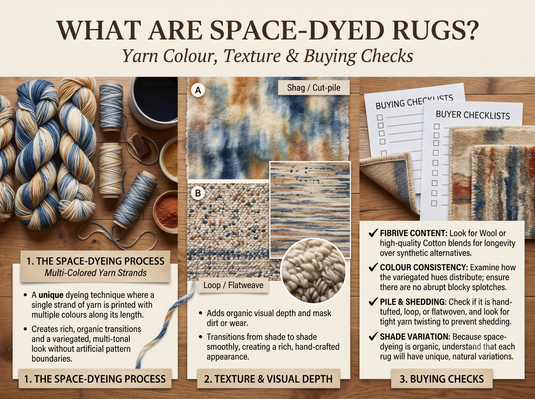
Some rugs contain subtle shifts of colour that seem to run through the yarn itself rather than sit in a clearly printed motif. A listing may describe this effect as space dyed. The term is worth understanding because it describes a colour technique, not a fibre, a weaving method or a promise of durability. Knowing the distinction helps you compare rugs that look similarly variegated but are made differently.
This guide explains space-dyed rugs and gives you practical questions for buying one. It covers sample variation, pattern, room coordination and care. It does not establish that The Ambiente currently offers a space-dyed range. You can explore modern rugs for available designs and ask about the documented dye technique of the individual piece you like.
What does space dyed mean?
Space dyeing applies different colours or colour depths at intervals along yarn. When that yarn is used in a textile, the sequence can create a varied visual effect. The final appearance depends on how the coloured yarn is arranged and on the construction of the textile.
The useful buying distinction is between colour applied along a yarn and a pattern described only by its finished appearance. A rug may look mottled, shaded or multicoloured without being space dyed. Ask the supplier whether the term identifies a documented production technique or is simply being used as a descriptive style name.
Space dyeing does not tell you whether the yarn is wool, cotton, regenerated cellulose or synthetic. Nor does it tell you whether the rug is hand-knotted, handloom, hand-tufted or machine-made. Each of those details still needs its own entry in the product specification.
How yarn colour becomes a rug pattern
Imagine a yarn moving between soft blue, grey and a deeper charcoal. Depending on the lengths of the coloured sections and the way the yarn is incorporated, those changes may read as small flecks, irregular bands or a broader tonal movement. A full-layout photograph helps reveal the effect better than a close-up alone.
The construction can influence how the variation is seen. A flat surface, a cut pile and mixed pile heights expose yarn differently. Ask to see both the overall rug and a detailed sample, especially when the design is intended to act as a quiet background beneath furniture.
Do not assume that an irregular effect means uncontrolled workmanship. Equally, do not accept every colour difference as a normal feature without an agreed reference. Before ordering, clarify what variation is expected and how the finished piece will be assessed against the approved sample and design.
Space dyed versus printed rugs
A printed pattern is generally discussed as colour applied to a textile surface, while space dyeing concerns colour variation along yarn. These are different production descriptions. A visual resemblance does not make them interchangeable, and neither description alone settles product quality.
For a printed rug, ask about the printing process, base textile and care. For a space-dyed rug, ask about the yarn, construction and how the colour effect is controlled. In both cases, request the actual composition and manufacturer instructions instead of inferring performance from the technique's name.
If you are comparing two products, keep the visual preference separate from the specification. One may have a sharper motif, another a softer tonal effect. The appropriate choice depends on the furniture, traffic and maintenance requirements. A technical label should help explain the difference, not supply a universal ranking.
Space dyed versus abrash, heathered and ombré descriptions
Rug listings may also use words such as abrash, heathered or ombré to describe colour variation. Do not treat all of them as proof of space dyeing. Ask the seller to explain the term as used for the particular product and show the full appearance it is intended to describe.
Some descriptions concern a visual effect, while others may refer to a material mix or a particular production history. For buying purposes, the most important step is to connect the name with the actual sample. If the listing uses several terms together, request a plain-language explanation rather than assuming they are synonyms.
A tonal shift can be beautiful when expected. It can be disappointing when you ordered what you thought was a uniform solid. Save the approved images and sample reference, and ask how much difference may occur between batches or between the sample and the larger finished area.
Ask for the complete specification
Record the generic pile fibres and percentages, the foundation or backing, the construction and the finished dimensions. Add pile height where relevant and ask about the edge finish. These details let you compare the rug with other products that may use different colour techniques.
If the rug is custom-made, identify which parts of the design are fixed and which have a deliberately varied effect. Ask whether an approved sample represents the complete colour sequence or only one part of it. A small sample can omit a darker section that becomes prominent in the full rug.
Ask the supplier what evidence supports any claims about colourfastness, commercial suitability or stain resistance. Space dyeing alone does not prove those properties. Where a project needs tested performance, request evidence tied to the finished product and intended use.
Decide whether you want subtle variation or a focal point
A restrained space-dyed appearance can add interest beneath plain upholstery. If the furniture and curtains already contain strong pattern, compare a sample that reads as quieter texture from across the room. Judge it at normal viewing distance rather than only through a macro photograph.
A more vivid multicolour effect can become the focal point. In that case, keep the other large surfaces controlled enough for the rug to feel intentional. Select one or two rug tones to connect with cushions, artwork or upholstery instead of trying to repeat every colour in the yarn.
The rug's role should be clear before you choose the palette. Is it meant to blend with the floor, ground a pale sofa or introduce movement into a minimal room? Answering that question reduces the risk of buying an attractive sample whose full-size effect competes with the whole interior.
Evaluate colour on the actual floor
Place samples beside the flooring and furniture. View them in daylight and under the lights used at night. Warm timber, grey stone and cream tile can each change the way the same yarn colours relate to the room. The sample should be tested where the rug will actually sit.
Move back to the doorway and sit at sofa height. A subtle variation may disappear at a distance, while a darker patch may become more noticeable. Turn a pile sample around as well, because directional reflection can change the apparent depth independently of the dye sequence.
Use photographs as records of the comparison, not as the sole colour authority. Screens and camera processing can shift tones. If colour approval is important, retain the physical sample identification and agree how the final rug will be compared with it.
Size and pattern distribution belong together
Measure the intended footprint before approving the design. A large rug displays more of the colour sequence and may feel visually busier than a small sample. Ask for the pattern or colour effect at the intended dimensions rather than scaling your expectations from a tiny swatch.
Consider where the sofa and coffee table will cover the rug. If a particular colour area is central to the look, ask how its distribution will work around the furniture. A design that looks balanced on an empty floor may read differently when a large table hides the middle.
Mark the footprint and review a full-layout image alongside it. Check doors and circulation as well as appearance. For custom sizing, confirm orientation, finished-size tolerance and sample approval. Our custom-rug measuring guide provides related planning steps.
Choose care through the fibre and construction
The colour technique does not establish washability. Care depends on the actual fibres, dyes, backing and construction. Read the manufacturer's instructions and ask what routine cleaning and spill response are appropriate for that product.
If the rug combines several fibres, the cleaning process must suit the sensitive components as well as the whole structure. Do not assume that the presence of wool makes every section suitable for the same treatment, or that a flat surface permits machine washing.
Keep the composition and care record together. If a spill occurs, avoid a chain of household treatments based on the idea that multicolour yarn will hide damage. Colour variation may make some soil less obvious, but it does not stop staining, residue or structural problems.
Inspect the sample and the delivered rug sensibly
Before purchase, ask what a normal variation looks like and what would count as a defect or an unapproved difference. The answer should refer to the product, sample or order terms, not a blanket statement that handmade means any variation is acceptable.
On delivery, check dimensions, orientation, edges and the overall colour distribution before placing furniture. View the rug in consistent light and from both ends if it has pile. Photograph any concern and contact the supplier promptly under the relevant delivery or return conditions.
Do not decide from a single close-up that the whole rug is wrong. A space-dyed effect should be judged at its intended viewing distance as well as in detail. At the same time, a technical description should not be used to dismiss damage, incorrect composition or a clear mismatch with the agreed specification.
Compare quotations and value
Build a comparison sheet that separates colour technique from material and construction. Include dimensions, care, backing, delivery and current return terms. This prevents two visually similar rugs from being treated as equivalent when their specifications differ substantially.
A higher price may reflect more than the dye process, and a lower price does not necessarily make a product unsuitable. Ask what is included and how the piece meets the room brief. A price comparison is useful only after you know which requirements are essential.
For a design project, include sample approval, production timing and replacement planning. A later batch may need fresh colour approval. If matching multiple pieces is important, discuss that requirement before production and record the supplier's approach rather than assuming all future pieces will be identical.
A worked example for a neutral living room
Imagine a beige sofa, dark timber table and pale stone floor. You want more texture without a strong geometric motif. Compare a uniform neutral rug with a variegated design containing cream, taupe and charcoal. Place both samples beside the sofa and look from the doorway.
The variegated option might connect the dark table to the pale floor more effectively, but check whether its charcoal sections become too dominant at the intended size. Request a full-layout image and mark the rug footprint. If the table hides the most useful colour transitions, compare another design instead of relying on the sample alone.
Then compare material, construction and care with the uniform option. Choose the piece that meets the decorative brief and the room's use. The decision is about the complete rug, not about assuming that a more complex colour technique is automatically more durable or more luxurious.
Frequently asked questions
Is space dyed a rug material?
No. It describes a colour technique applied to yarn. The fibre and construction must be specified separately, and those details remain essential to care and placement.
Are all multicoloured rugs space dyed?
No. Different production methods can create a varied appearance. Ask the supplier to explain the documented technique for the individual product instead of identifying it from the finished look alone.
Can it work in a minimalist room?
Yes, if the palette and visual scale support the room. A restrained tonal effect can add interest while remaining quieter than a high-contrast motif. Test the full design beside the furniture.
Does the technique guarantee colourfastness?
No. Request relevant product evidence where that performance matters. The name of a dye technique is not a substitute for testing, care instructions or a written specification.
Will a custom rug match a small sample exactly?
Clarify what the sample represents and what variation is expected. Record the approved reference, intended dimensions and acceptance terms. A full-size layout can reveal colour distribution that a small swatch does not show.
Technical reference and related reading
For a technical description of yarn dyeing and space-dye methods, consult the INFLIBNET textile-colouration teaching resource. For related rug topics, read our natural and synthetic dye guide and ikat pattern guide. A documented production technique and a physical sample together make a better buying basis than a decorative label alone.
Related rug guides
Need help choosing a rug or carpet?
Ask The Ambiente about rug sizes, materials, colours or the right choice for your room.