A rug can make a hostel, dorm or paying-guest room feel more settled without demanding a complete makeover. It can define a bedside area, make a reading corner more inviting and connect furniture you did not choose yourself. Student accommodation also creates practical constraints: shared space, limited storage, cleaning access and the need to move at the end of a term or tenancy. A useful rug should fit those conditions as well as your taste.
This guide focuses on rugs for hostel, dorm and PG rooms in India. It offers a measured way to choose size, materials, colour and care without assuming that every accommodation permits the same changes. Explore The Ambiente's modern rugs for available designs, then compare individual specifications with your room and budget.
Check the room's rules before shopping
Ask what is permitted in the accommodation. An ordinary removable rug, adhesive floor products and permanent carpeting are different changes. Check with the manager where a proposed installation could affect the floor or interfere with cleaning and access. Do not rely on a friend's rules from another property.
In a shared room, agree on the placement with the other occupants. A rug in a common walkway affects everyone, even if only one person buys it. Discuss cleaning responsibilities, shoes, food and what happens when the owner moves out. A clear agreement prevents a small decorative purchase becoming a daily irritation.
Keep doors, required access and circulation clear. The rug should not be used to disguise a damaged or damp floor. If the room has a leak or persistent moisture problem, raise it with the manager and choose another placement until it is addressed.
Measure the usable floor, not only the room
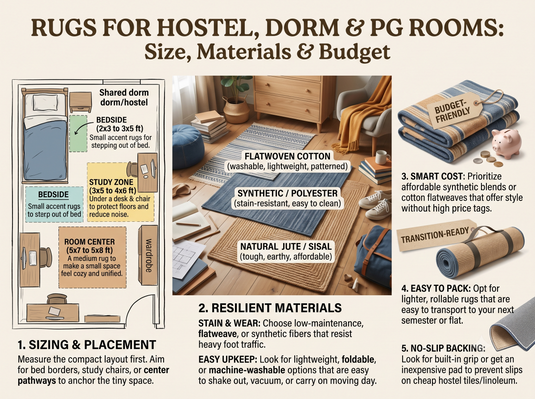
Hostel furniture can leave irregular pockets of space. Record the bed, desk, wardrobe and door positions before selecting a size. Measure the open area that the rug can actually occupy, allowing for furniture operation and the route between the entrance and the bed.
Draw a simple plan and mark two possible footprints. Include the desk chair pulled out and the wardrobe door open. A rug that fits when everything is tucked away may become awkward during normal use. Test the outline with a floor-safe removable method if the property allows it.
Do not assume that a large rug will improve every small room. It may connect the furniture successfully, but it can also make cleaning and moving more difficult. A smaller bedside or reading-area rug may be more useful when the room is tightly furnished.
Decide which activity the rug should support
Start with one purpose. Is the rug mainly for stepping out of bed, sitting on the floor, defining a reading corner or connecting two beds visually? A specific role makes the size and material decision easier than trying to cover every remaining centimetre.
For a bedside rug, check where your feet naturally land and whether the edge lies in the main route. For floor seating, consider comfort, cleaning and whether the area remains free of furniture. For a reading corner, include the chair and side table in the footprint.
A rug beneath a desk needs separate scrutiny. Rolling chairs and repeated chair movement can interact poorly with some surfaces. Ask whether the product is suitable rather than choosing a thick rug because it feels comfortable in a showroom. The working area must remain stable and usable.
Single room versus shared room layouts
In a single room, you can coordinate the rug closely with bedding and furniture. Start with the largest fixed elements and choose a palette that connects them. Keep enough visible floor and open access for ordinary cleaning.
In a shared room, a restrained common palette may be easier than a strong pattern that only one person likes. Alternatively, each occupant can choose a small personal bedside rug if the layout permits. Check that separate pieces do not overlap or create an unstable sequence of edges.
A central rug can define the shared area, but it should not force someone to cross another person's belongings. Review the actual routes between both beds, desks and wardrobes. A balanced photograph is less important than a room everyone can use comfortably.
Compare materials through care and use
Write down the conditions: everyday shoes, snacks, spills, pets if permitted, dust and the cleaning equipment available. Then compare the actual product instructions. A fibre name alone does not tell you whether a rug can be washed, moved easily or used under a chair.
Wool, cotton-rich products, plant-fibre rugs, lustrous blends and synthetic options can have different constructions and care requirements. Ask for the generic composition, backing and approved routine. A textured appearance does not establish durability, and a natural material is not automatically the easiest student-room choice.
If professional cleaning is required, decide whether that service is practical for your location and schedule. If washable care is essential, request explicit instructions for the finished rug. Check size and drying requirements as well as the washing method before treating the label as a convenience guarantee.
Weight and handling matter in student accommodation
Think about stairs, lifts and the route to the room. A rug that is manageable for delivery may be harder to pack and move alone later. Ask for product dimensions and any handling information where the piece is large or unusually heavy.
Do not use portability as an excuse to buy an unstable product. A lightweight piece may need a suitable pad, while a heavier rug still needs compatible placement. Assess both handling and everyday use. The goal is a manageable textile that remains useful on the floor.
If your accommodation changes regularly, consider alternative future uses. A modest bedside rug might later fit a study or rental bedroom. Keep those dimensions in your records, but do not assume that folding or cutting a rug is an acceptable way to adapt it to a new room.
Choose a compatible pad and check doors
Identify the floor material and ask about the finish where needed. A pad should be suitable for both the floor and the rug. Confirm compatibility with the relevant supplier, especially when the property uses recently finished wood or another sensitive surface.
Avoid adhesive fixes unless they are expressly permitted and suitable. A removable product can still leave an unsuitable residue or interfere with maintenance. Keep the pad instructions and check its condition during cleaning rather than waiting until the end of your stay.
Open the door over the proposed rug-and-pad combination. Include wardrobe and bathroom doors where relevant. Also test how the edge behaves when you get up from bed or move a chair. For a detailed floor comparison, see our rug-pad and underlay guide.
Use colour to connect the room's fixed furniture
A student room may contain mismatched timber, metal and upholstery. Choose one or two colours from the existing bedding or furniture to connect through the rug. A controlled pattern can make the room feel intentional without requiring new furniture.
Test the sample under the room's actual light. Warm lamps and cool daylight can change the relationship between neutral tones. A rug called grey may be too cool beside warm wood, while a beige may have an undertone that clashes with the bedding.
Avoid choosing a dark rug solely to hide every spill. Some marks become more visible on darker backgrounds, and colour does not prevent staining. Match the palette to the room and choose care appropriate to the product. Appearance and maintenance are separate parts of the decision.
Keep pattern scale proportionate to what remains visible
A large central motif may be mostly hidden under a bed. A strong border may draw attention to a footprint that is too small. Ask for the full layout at the size you are considering and imagine the furniture on top of it.
A smaller repeated pattern can read as texture in a compact room. A bold design can also work if it has a clear role and other surfaces stay quieter. Compare the whole composition from the doorway rather than deciding only from a detailed product photograph.
For a small bedroom layout, use our small-bedroom rug placement guide. Adapt the suggestions to hostel furniture and shared-room access rather than following a staged room exactly.
Build a budget that includes the practical extras
Set a total amount for the rug, compatible pad and any relevant delivery or care cost. Compare current product prices directly. A general guide cannot establish today's offers, and an attractive discount is not useful if the piece does not fit the room.
Separate essential requirements from preferences. Correct size, stability and manageable care should usually come before an exact pattern. If the preferred material exceeds the budget, compare another fully specified option rather than accepting vague composition or unsuitable maintenance to preserve the look.
Check return and custom-order terms before buying. Measuring mistakes can be expensive, particularly for made-to-order work. Our budget-focused rug guide offers related planning ideas, but use the seller's current terms for the actual purchase.
Make cleaning a shared routine
Agree on the vacuum setting and keep the care instructions accessible. In a shared room, one person's well-intended treatment can damage a rug another person has been told to clean differently. A simple common routine is better than several competing household remedies.
Remove dry soil regularly according to the product guidance and the room's use. Keep food and drinks in places where spills can be handled promptly. If liquid reaches the rug, follow the approved response and record any treatment already applied before seeking professional help.
After mopping, allow the floor to dry before replacing the rug and pad. Check near water bottles, plant pots and windows where moisture may recur. A textile should not be left over a damp patch because it makes the room look tidier.
Plan the end-of-term move
Photograph the rug's condition and retain its specification before packing. Remove loose soil and arrange suitable cleaning if needed. Allow the whole construction to dry before wrapping. Packing a damp rug can create problems during transport or storage.
Ask for a rolling or support method appropriate to the piece. Avoid sharp folds, dirty vehicle floors and heavy luggage on top. A valuable or damaged rug may need specialist handling rather than improvised packing to fit a suitcase.
At the next room, inspect the floor and confirm pad compatibility again. Test the new footprint before placing furniture. A rug that fitted one hostel room may need a different role in another, so use the measurements and care records you kept rather than assuming the old arrangement will repeat.
A worked shared-PG-room example
Imagine two beds along opposite walls with desks at the window. The central area serves as the route to the wardrobes and entrance. A large rug might look inviting there, but first open the wardrobes and pull both desk chairs back to their working positions.
Test a central outline and two smaller bedside outlines. If the central option narrows access or catches the chairs, the separate bedside pieces may be more practical. If the central route remains clear and both occupants want a common sitting area, one shared rug might serve the room better. The choice depends on the actual plan.
Next compare care, floor compatibility and total cost. Agree who buys the pad, who maintains the rug and who takes it when someone moves. Those everyday details can matter as much as the colour scheme in making the purchase successful.
Frequently asked questions
What is the best rug size for a hostel room?
There is no universal size. Measure the usable footprint after allowing for doors, furniture and circulation. Choose the role first, then test the outline in the actual room.
Should I put a rug under my desk chair?
Only after confirming that the product suits repeated chair movement and the chair type. Check stability and operation. A decorative or thick rug is not automatically a suitable desk surface.
Is washable always better?
It may be convenient, but verify the instructions for the finished product, equipment capacity and drying. A small professional-clean rug may be manageable for some students, while a large washable piece may be impractical to handle.
Can roommates use separate rugs?
Yes, if the layout remains safe and useful. Avoid overlaps and unstable edges, agree on cleaning and keep shared routes clear. Test the placement with both occupants' furniture in use.
What should I ask before buying online?
Request dimensions, generic composition, construction, backing, care, current delivery and return terms. Share the room plan and floor information so the supplier can discuss suitable current options rather than guessing from a student-room label.
Choose a rug that supports everyday life
A successful student-room rug is one that fits the real floor plan, stays manageable and has a care routine everyone understands. Measure first, confirm permissions where needed and compare complete specifications. The decorative result will be more satisfying when the room remains easy to use, clean and move from.
Related rug guides
Need help choosing a rug or carpet?
Ask The Ambiente about rug sizes, materials, colours or the right choice for your room.