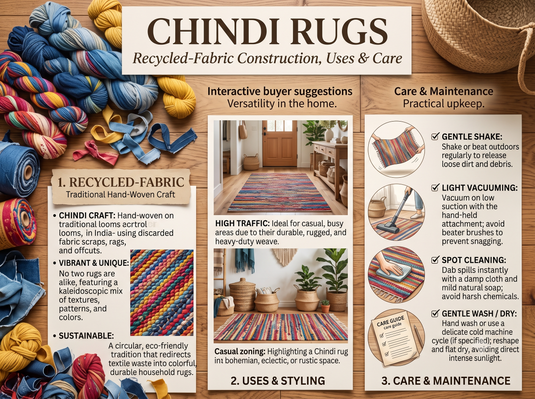
A Chindi rug can bring a relaxed, colourful character to a room through visible fabric strips and an irregular surface. It is often discussed alongside recycled-fabric or rag rugs, but the label alone does not establish the precise composition, recycled percentage or care method of every product. The practical buying questions are about what has been used, how it is held together and where the rug will work well.
This guide explains how to evaluate a Chindi rug for a home in India, including material information, construction, room placement and maintenance. It is not a statement that The Ambiente currently stocks Chindi products. For available alternatives, explore our handloom rugs and compare the specifications of the individual designs that suit your space.
What is a Chindi rug?
Chindi is commonly used in the rug trade for rag-style pieces made with fabric strips, often incorporating leftover or recycled textiles. Manufacturers may use cotton-rich materials, mixed fabrics or other combinations. Ask the seller to identify the actual fibres and how the recycled claim is supported for the product you are considering.
The visible strips can create a textured, varied appearance. A piece may contain many colours or a more restrained palette. Neither the colour mix nor an uneven-looking surface proves a particular recycled percentage. A useful listing should explain the composition and construction rather than relying on the charm of the word alone.
Keep the product reference and care information with the invoice. Mixed-material rugs can be difficult to identify later if the only record is a decorative name. A cleaner should know the declared fibres, backing and dye information as far as the supplier can provide it.
Fabric strips and construction are different parts of the story
Ask how the rug is assembled. A woven rag rug has a structure beyond the visible strips, including the yarns that hold the fabric in place. Other rag-style products may use different methods. Do not assume that every item sold as Chindi has the same construction or the same repair possibilities.
Request photographs of the face, reverse and edges. Look for a clear explanation of the finishing and whether additional backing is present. The way the edges are secured matters when the rug is lifted, vacuumed or placed where furniture moves frequently.
A handmade description should be supported by product-specific information. Irregularity can be part of the character, but it is not proof of a method by itself. Ask what variation is normal and what would be considered a loose or damaged area needing attention.
Verify the recycled-fabric claim
A recycled claim should identify what portion of the rug it concerns. Does it refer to the visible fabric strips, the whole textile or a particular component? Ask whether the percentage is documented and whether the materials are production leftovers, previously used textiles or another stated source.
Avoid turning a recycled ingredient into a claim that the entire product has no environmental impact. Foundation yarn, dyes, finishing, transport and cleaning are additional parts of the story. If a certification is mentioned, request its scope and the product reference it covers.
Transparent information is more useful than broad terms such as completely green. You can value material reuse and still ask practical questions about composition, performance and disposal. Our eco-friendly rug guide offers related buying questions without making every rag rug equivalent.
Compare feel and surface stability
Use an actual sample or inspect the piece where possible. Feel the surface, check whether loose strips catch easily and observe whether the edges lie as intended. A textured look can be appealing, but it should remain practical for the furniture and cleaning equipment in the room.
Consider who uses the space. A room where people sit on the floor has different tactile needs from a decorative corner. A household with pets may need to assess how claws interact with exposed strips or loops. Do not rely on a general durable label without asking how the product is intended to be used.
If the texture is uneven, check how small furniture feet sit on it. A coffee table that rocks on the sample or catches when moved deserves attention before buying a full-size piece. The complete furniture footprint matters more than whether the rug looks inviting in an empty-room photograph.
Choose the colour relationship deliberately
A multicolour Chindi rug can become the room's main accent. Start by identifying one or two colours that connect with the existing furniture. You do not need to repeat every strip colour in cushions and artwork; doing so can make a small space visually crowded.
For a quieter room, compare a restrained palette or a tonal rag-style design. Place the sample beside the floor and sofa to check undertones. An apparently neutral mix may contain stronger warm or cool sections than a close-up image suggests.
Ask for the full rug image as well as detailed photographs. A sample may not show the distribution of colour across the entire piece. If variation between pieces is expected, clarify whether you are buying the photographed rug or an item from a variable batch.
Living-room placement: connect the furniture first
Measure the seating area and mark the intended footprint. Check sofa legs, chairs and the coffee table. A small colourful rug might look attractive by itself but leave the seating disconnected. A larger footprint may be more coherent, provided it does not obstruct circulation.
Review how much of the fabric-strip pattern will remain visible. If a large table covers the central area, the edges and border become especially important. Ask whether the pattern distribution at the selected size is represented by the listing image.
Use a compatible pad where appropriate and confirm it with the flooring and rug suppliers. Lightweight or flexible pieces may need additional stability, but the pad should not be an improvised adhesive solution. Test doors and exposed corners after the rug and support layer are in place.
Bedroom and study placement
In a bedroom, decide whether the rug will sit under the bed or serve a smaller bedside area. The latter may be easier to lift and clean, but it needs a stable edge where you step down. Check the combined rug-and-pad height and avoid corners in the main route.
For a study, consider the desk chair separately. A rolling chair can create repeated movement over the surface. Ask whether the specific product is suitable instead of assuming that a rag rug works beneath any desk. A decorative rug beside a reading chair may have a different role.
Check cleaning access around bed frames and heavy furniture. A washable claim is useful only when the item can be handled according to its instructions. A large rug that you cannot move or dry properly may be less practical than its material description initially suggests.
Kitchen and entrance use need extra scrutiny
A rag-style rug should not automatically be treated as an absorbent entrance mat or a washable kitchen mat. Those locations involve moisture, grease, shoes and frequent cleaning. Request explicit product suitability and care instructions before selecting one for that job.
Near an entrance, check whether the piece lies securely and allows the door to operate. Where wet shoes regularly arrive, use an appropriate entry-mat system and keep a decorative rug outside the wet zone unless its manufacturer supports that use. Colourful strips do not make soil harmless.
In a kitchen, evaluate spill response, drying and movement underfoot. If the rug is not suitable for the conditions, consider a different product rather than trying to make it work through extra treatments. The intended use should guide the purchase, even when the decorative effect is appealing.
Washability must be confirmed for the finished rug
Cotton content does not by itself establish machine washability. Mixed fibres, dyes, backing, edging and dimensions can change what is permitted. Read the product's instructions and ask for clarification if the listing only says washable without describing the method.
If machine washing is allowed, confirm capacity, cycle, temperature and drying guidance. A heavy wet rug can be difficult to handle even when a small sample feels light. Do not assume that a domestic machine is appropriate for every size. Never improvise a drying method that the manufacturer prohibits.
If the instructions require professional cleaning, plan for that service. Tell the cleaner about mixed composition and any previous colour transfer. A rag rug's casual appearance does not justify aggressive scrubbing, bleaching or prolonged soaking without product-specific approval.
Ask about colour transfer before purchase
Multiple fabric colours create a reason to ask about dye stability and the approved cleaning process. The appearance alone cannot establish whether colour will transfer under moisture or friction. Request relevant manufacturer information rather than experimenting on the finished rug with household chemicals.
Follow any approved testing or pre-cleaning guidance provided for the product. If colour transfer occurs during an instructed check or cleaning, stop and seek advice. Do not continue wetting the rug in an attempt to remove the transferred colour without understanding what is happening.
Keep the rug off a damp floor after mopping and monitor areas near plant pots or balcony doors. A dry-looking face does not prove the reverse is dry. Where moisture exposure is recurring, change the placement rather than relying on the rug's pattern to hide evidence of the problem.
Maintain edges and loose material carefully
Use the recommended vacuum setting and avoid tools that catch fabric strips or edges. If a strip lifts or a seam loosens, ask the supplier how it should be assessed. Pulling, cutting or gluing it without guidance can change the structure and make a repair more difficult.
Lift furniture rather than dragging it across the surface. Check the edges and pad during cleaning, especially where people step onto the rug repeatedly. An early local repair may be simpler than waiting until movement causes a larger damaged area, but suitability should be assessed by someone familiar with the construction.
For related construction questions, see our kilim and handloom guide. Use it to understand woven structures, while keeping the actual Chindi product's care and repair instructions as the primary reference.
Compare price through usable value
Record size, composition, construction, recycled-content evidence, backing and care for each shortlisted rug. Add the current price, delivery terms and return conditions. This makes differences visible that a colourful product photograph may not explain.
A lower-cost piece can be useful if it suits the job and is maintained appropriately. A higher-cost piece may offer a particular design, finishing or documented material story. Neither price alone proves environmental benefit or long-term performance. Ask what you are buying and how it fits the room.
If a product is made to order, clarify expected colour variation and sample approval. A variable fabric-strip design may not reproduce every colour in the same place. Agree the acceptable result in advance and keep that reference with the order.
A worked example for a small reading corner
Imagine a plain armchair, timber side table and neutral walls. You want a colourful rug to make the corner feel distinct from the rest of the living room. Measure the chair and table footprint, then test an outline that includes the necessary legs without extending into the main walkway.
Compare a vivid multicolour design with a quieter two-tone alternative. Place both beside the chair fabric and flooring. Check whether the surface supports the table securely and whether the piece's edge remains stable when you stand up from the chair.
Finally verify composition, recycled claims and cleaning. If the room includes a pet or frequent drinks, discuss those conditions explicitly. The chosen rug should create the desired visual story and remain practical to maintain, rather than being selected from a recycling claim alone.
Frequently asked questions
Are all Chindi rugs made from recycled cotton?
Do not assume that. Ask for the actual fibre mix, recycled percentage and scope of the claim. Cotton-rich, mixed-fabric and other products may share a rag-style appearance while having different specifications.
Is every Chindi rug handmade?
A product's construction needs its own evidence. Request the supplier's explanation and photographs. Visible variation or loose-looking texture is not sufficient proof of a particular manufacturing method.
Can I wash it at home?
Only according to the finished rug's explicit instructions. Fibre content, dyes, backing, size and drying requirements all matter. A cotton ingredient alone does not answer the question.
Is it a good choice for pets?
Assess the actual surface, stability and care against your pet's behaviour. Exposed strips or loops may need particular consideration. Ask the manufacturer about intended use and inspect a sample where possible.
What if two pieces look different?
Clarify expected variation before buying and establish whether the listing shows the exact piece or a representative design. Keep the approved reference and contact the supplier promptly if the delivered product differs from the agreed specification.
Product-research reference
For a manufacturer example of recycled-cotton Chindi construction, see Sheeltex's product explanation. It describes that manufacturer's approach, not every Chindi rug and not Ambiente inventory. Your final decision should follow the documented specification of the piece you are actually purchasing.
Related rug guides
Need help choosing a rug or carpet?
Ask The Ambiente about rug sizes, materials, colours or the right choice for your room.