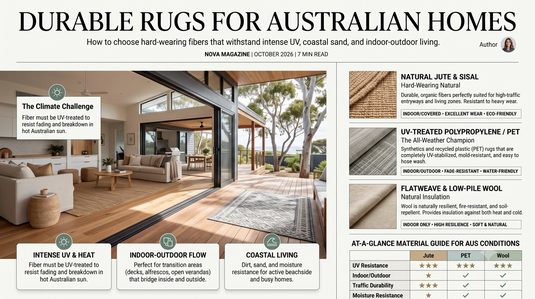
Choosing a durable rug for an Australian home starts with the home itself. A shaded city apartment, a beachside house, a humid northern room and a cool inland living space do not expose a rug to the same conditions. There is no single Australian climate or national decorating preference that makes one fibre right for everyone.
The useful comparison is wool, synthetic and cotton in the context of your actual room. Think about sunlight, moisture, tracked sand, heating, furniture and the amount of cleaning you can manage. This guide explains how to make that comparison while keeping the rug's construction and care label central to the decision.
Describe the room before choosing a material
Write a short room profile. Note whether the rug will sit near an external door, beside large windows or in a space that is difficult to ventilate. Record whether people wear shoes indoors, whether pets use the area and whether the rug will be under dining chairs. These details are more useful than the home's postcode alone.
Climate affects the choice through the conditions inside the room. Air conditioning, insulation, shade and ventilation can make an indoor space different from the outdoor weather. A coastal location does not mean every rug will get wet, while an inland house can still have a damp problem. Inspect the actual floor and room rather than working from a regional stereotype.
Keep this profile beside the product specifications. A rug shortlisted for a quiet bedroom should not automatically become the choice for the main entrance. If the home has several different zones, buying different constructions can be more practical than repeating the same rug material everywhere for visual consistency.
Wool: comfort and texture with thoughtful placement
Wool can suit a living room where tactile comfort and a substantial appearance matter. A compact wool rug can work with timber furniture, leather seating and both colourful and restrained interiors. Choose the construction and pile profile according to the amount of traffic rather than assuming that a thicker wool rug is always more durable.
In cooler rooms, the rug can make a hard floor feel more comfortable underfoot. In warmer rooms, a lower-profile wool surface may provide the desired softness without the visual heaviness of a long pile. Neither choice replaces appropriate room ventilation or other measures needed to manage moisture.
Ask for the complete fibre composition, especially where the product contains a blend or decorative highlights. Silk or viscose can alter how the rug needs to be cleaned. Compare individual wool rugs and read the care information before deciding which one fits the room.
Synthetic rugs: compare the specific fibre
Synthetic is an umbrella term. Polypropylene, polyester, nylon and other fibres should not be treated as identical. The product's performance depends on the yarn, construction and backing as well as the fibre. Request a specific composition and intended-use description so that you can compare products fairly.
A synthetic rug can be attractive when cost, a particular pattern or a documented cleaning method is important. However, an indoor rug does not become suitable for a veranda because it contains polypropylene. The backing, dyes, edges and manufacturer's environmental-use recommendation all need to support the proposed placement.
Check how the supplier distinguishes stain resistance, appearance retention and cleaning convenience. A product that is relatively easy to blot after a water-based spill can still show oily stains or flatten along a busy route. Choose on the documented characteristics of the rug rather than a general promise that synthetics are effortless.
Cotton: a relaxed option with care limitations
Cotton rugs can create an informal look in bedrooms, occasional seating areas and smaller spaces. A flatwoven cotton rug may suit a room where you want a light visual footprint rather than a deep pile. It may also be easier to move than a heavy rug of similar dimensions, depending on construction.
Do not assume cotton means machine washable. Size, dye stability, shrinkage, finishing and backing can make machine washing unsuitable. If washing is important to your decision, require explicit instructions for the particular product and check that your machine can handle it safely. A washing symbol for a small mat does not apply to a larger unrelated rug.
For a busy living room, inspect edge strength and stability under furniture. A lightweight rug can shift or wrinkle if it is not supported appropriately. A suitable floor-compatible pad may help, but the assembly must still lie securely. Cotton is a useful option when its practical characteristics match the space, not a universal low-maintenance solution.
Choosing for humid rooms
The priority in a humid setting is keeping the room, floor and rug dry enough for normal use. Investigate recurring dampness or condensation before covering the floor with any rug. A different face fibre does not resolve moisture trapped beneath the backing or pad.
Avoid thick assemblies that are difficult to lift and inspect if the room has a history of moisture problems. Check beneath the rug periodically, especially after spills or cleaning. If the backing feels damp or there is a persistent musty odour, identify the cause instead of adding fragrance or repeatedly wet-cleaning the surface.
Use only rugs whose manufacturers recommend the proposed conditions. A dry, ventilated indoor lounge and a partially exposed outdoor entertaining area need separate assessments. For a veranda, look for documented outdoor suitability and follow the specified storage and care arrangements during wet weather.
Choosing for strong sunlight
View the room at different times of day. A rug that is shaded in the morning might receive prolonged direct light in the afternoon. Sunlight can change the appearance of dyes and fibres, so placement and window treatments matter alongside the choice of colour.
Ask what the manufacturer says about exposure and whether any fading is excluded from the warranty. A statement such as fade resistant needs product-specific meaning; it should not be interpreted as a promise that the rug will never change. Dark and pale colours can both show uneven exposure in different ways.
Rotate a rug when the shape and furniture arrangement allow it, and use curtains or blinds where practical. Rotation spreads exposure rather than restoring faded areas. If one end must always remain under a window, consider a rug whose placement can be changed more easily or a different arrangement for the furniture group.
Sand, dust and grit: choose for cleaning access
A home near a beach or dusty outdoor area may need particular attention to tracked particles. These can sit between yarns even when the rug looks reasonably clean. Start with a suitable entry system and a household routine for removing shoes or cleaning footwear where appropriate.
In the main seating area, a lower or more accessible pile may be easier to keep free of dry debris than a long shag. Match vacuum settings to the rug's care instructions, and keep fringes away from suction or rotating equipment that could catch them. Cleaning access matters under furniture as well as in the open centre.
Choose a pattern for the visual effect you enjoy, but remember that concealing dust is not the same as removing it. Lift the rug when appropriate to inspect the pad and floor. A rug that looks forgiving still needs a routine that keeps grit from building up.
How materials can support different decorating directions
There is no single Australian decor taste. A coastal room can use wool, a city apartment can use cotton, and a traditional interior can include a synthetic rug. Begin with the room's colours, furniture proportions and desired texture instead of assigning a material to a lifestyle label.
For a relaxed room with pale timber and linen upholstery, compare softly varied tones and a texture that does not compete with the furniture. For a bolder room, a patterned rug can provide a colour reference for cushions or art. A flatweave may keep a compact room visually light, while a pile rug may make a larger seating group feel more grounded.
Look at flatwoven rugs beside pile options in similar colours. The difference in structure can be more significant than the difference in fibre name. Assess the sample on the floor, where the texture and shadows will be seen in normal use.
Use size and layout to improve everyday performance
A rug should support the furniture arrangement and leave clear circulation where needed. Tape its proposed outline on the floor, then walk through the room as you normally would. Open doors, extend recliners and move dining chairs if they will sit on the rug.
In a living room, a rug large enough to connect the sofa and chairs can look more coherent than a small piece isolated under the coffee table. In a dining area, assess chair positions when pulled back. A rug edge repeatedly catching a chair is a practical problem that changing from wool to synthetic will not fix.
Choose a pad that suits both the rug and the floor finish. Ask about heated floors, sealed timber and other specific substrates where relevant. The right pad should support stability without introducing an unnecessarily high edge or a material that is incompatible with the floor.
What ratings and evidence can help?
For fitted carpet, a recognised grading system can make performance claims more useful. The Carpet Institute explains the Australian Carpet Classification Scheme, including separate residential and commercial classifications and identifiable registered products. Check evidence for the exact carpet being offered.
Do not assume that a loose area rug carries an ACCS rating, or that any The Ambiente rug has a particular certification. Ask the supplier what product evidence exists and what use is recommended. When there is no formal rating, clear construction details and a written suitability recommendation are still preferable to a vague description.
Treat stair use as a separate decision. A rug suitable under a sofa is not automatically appropriate as a stair runner. The construction, finishing and installation requirements are different. Get an appropriate professional assessment for fitted carpet or runners where secure installation is essential.
Buying online from within or outside Australia
Check the practical terms before purchasing: delivery destination, freight charges, taxes or import charges where applicable, return conditions and the process for resolving a damaged delivery. These details can change, so obtain current confirmation for your order rather than relying on a general blog statement.
If you are browsing an overseas retailer, confirm that it can fulfil your particular destination. This article does not promise Australian shipping from The Ambiente. Product availability, delivery and returns need to be checked directly for the item and address before payment.
Request photographs, dimensions, composition and care instructions for the exact rug. Ask whether colours are represented by a sample or only screen images. A slightly different tone may be acceptable; a different construction or unworkable cleaning requirement may not be. Settle those questions while the order is still easy to change.
A care routine for the rug you actually own
Build the routine around the manufacturer's instructions, the room profile and observed use. Remove dry soil using compatible equipment, respond promptly to spills and inspect edges and the underside when access allows. Increase attention to entrances and the places where people stand or turn repeatedly.
For wet marks, absorb the liquid and avoid spreading it through the pile. Do not apply a universal mixture of vinegar, bleach or detergent to every fibre. The rug may have dyes, a backing or a blend that reacts differently from the face material. Stop if colour transfers or the texture changes.
Seek appropriate specialist help for persistent staining, unstable dyes or valuable handmade pieces. Our wool and synthetic comparison can help clarify material differences, while the product's own care instructions should govern treatment of the actual rug.
Three room examples
In a shaded, cool lounge with a timber floor and modest traffic, a well-constructed wool rug may be an appealing starting point. Test size, comfort and care requirements, then choose the colour under both daylight and lamps. A suitable pad can complete the arrangement without requiring an exceptionally thick pile.
In a humid home where the main living room stays dry but the covered deck is exposed to rain, assess those spaces separately. An indoor rug may suit the lounge, while the deck requires a product expressly designed for its exposure. Do not buy one construction for both locations simply to repeat the design.
In a family room close to the garden, compare a compact wool rug with a suitably specified synthetic option and focus on grit control, spills and easy cleaning access. A lightweight cotton rug may suit a quieter bedroom better. These examples show why placement is a stronger decision tool than treating a fibre as universally best.
Make the final choice with a clear checklist
Before ordering, confirm the material, construction, dimensions, recommended location, pad compatibility and care requirements. Then confirm delivery and return arrangements for your address. If two rugs remain equally appealing, choose the one whose documented practical requirements fit your normal routine more comfortably.
A durable rug for an Australian home is not defined by a regional style label. It is the rug that works in the actual room, under the actual light and with the people who use it. Comparing wool, synthetic and cotton through those conditions gives you a more reliable decision and a space that feels personal as well as practical.