Sage Green vs Olive Green Rugs: Choosing the Right Shade. A practical guide to rug styling in Indian homes.
Understanding the colour
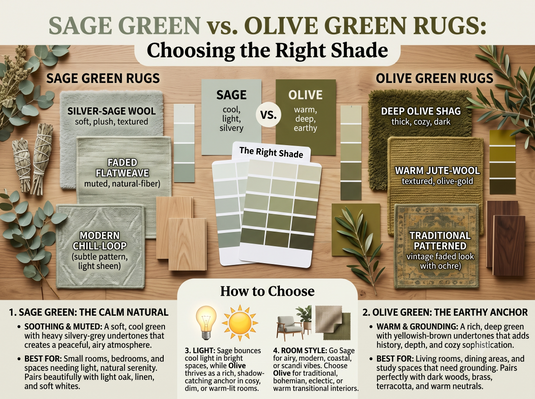
Sage green has a cool, muted grey undertone, whereas olive tends to be warmer and earthier. Both can work beautifully in Indian homes, but the right shade depends on your sofa, flooring and room lighting.
Matching furniture and flooring
For ivory upholstery and pale marble, sage adds a light, subtle layer. An olive rug offers richer contrast with beige sofas, walnut furniture and terracotta accents. On grey stone, sage can look cohesive, while olive creates a deliberate warm-and-cool pairing.
Choosing a balanced design
In living rooms, measure the sofa and chairs before choosing a rug. A practical layout often places at least the front legs of the main furniture on the rug. For bedrooms, allow coverage beside the bed where people stand. Always check the actual product dimensions rather than assuming a standard size.
Rug placement and sizing
Consider how a rug looks in daylight versus warm evening lighting. Wool often has a quieter texture while bamboo silk may show more sheen, changing the apparent colour. Examine close-up photos, construction and care instructions for the exact product.
Material and care
With patterned furniture, choose a relatively subtle green rug. With plain upholstery, a geometric or textured design can introduce interest. Sage may be an easier fit for soft neutrals, while olive makes a stronger statement in rooms with tan or rust accents.
Shop the collection
Explore green rugs at The Ambiente, and compare living room rugs or bedroom rugs. Check the actual product colour, available size and shipping conditions before ordering.
Common questions
Frequently asked questions: Will sage green work with a beige sofa? Yes, generally it creates a quiet, neutral-friendly palette. Is olive too dark for small rooms? Not necessarily, provided there is enough contrast and light. Do green rugs work with wooden floors? Yes; olive echoes warm wood tones while sage adds cooler contrast.
Detailed styling and buying guide
Understanding green undertones
When planning understanding green undertones, begin with the real room rather than a studio photograph. The relationship between sage green and olive green is influenced by natural light, furniture proportions, the rug's construction and nearby finishes. Look closely at the room's floor and architecture, because undertones can become more obvious when materials sit next to each other. A design that appears understated in isolation may become the centre of attention beneath a sofa or bed. Compare several full-room photographs and close-up textile details before deciding which direction feels coherent.
Measure the exact area the rug should cover and consider how people move around the furniture. Try marking the intended outline on the floor using removable tape. This makes it easier to see whether the rug anchors the seating arrangement or feels disconnected from the main pieces. Material also affects the result: wool often reads softly textured, while fibres with sheen may reflect light and make a shade seem different from another angle. Always check the listed size, fibre composition, care instructions and actual product pictures instead of relying on a category name.
For a practical styling test, place photographs or samples beside your upholstery during the day and again after switching on evening lights. Consider whether the rug should add contrast, echo existing colours or introduce texture to an otherwise simple palette. Keep busy patterns in balance: if curtains and cushions already have a prominent design, a quieter rug can provide visual rest. If the furniture is plain, thoughtful patterning may make the arrangement feel richer. Aim for a comfortable, usable home, not simply a coordinated catalogue image.
Sage green with a beige sofa
When planning sage green with a beige sofa, begin with the real room rather than a studio photograph. The relationship between sage green and olive green is influenced by natural light, furniture proportions, the rug's construction and nearby finishes. Look closely at the existing furniture, because undertones can become more obvious when materials sit next to each other. A design that appears understated in isolation may become the centre of attention beneath a sofa or bed. Compare several full-room photographs and close-up textile details before deciding which direction feels coherent.
Measure the exact area the rug should cover and consider how people move around the furniture. Try marking the intended outline on the floor using removable tape. This makes it easier to see whether the rug anchors the seating arrangement or feels disconnected from the main pieces. Material also affects the result: wool often reads softly textured, while fibres with sheen may reflect light and make a shade seem different from another angle. Always check the listed size, fibre composition, care instructions and actual product pictures instead of relying on a category name.
For a practical styling test, place photographs or samples beside your upholstery during the day and again after switching on evening lights. Consider whether the rug should add contrast, echo existing colours or introduce texture to an otherwise simple palette. Keep busy patterns in balance: if curtains and cushions already have a prominent design, a quieter rug can provide visual rest. If the furniture is plain, thoughtful patterning may make the arrangement feel richer. Aim for a comfortable, usable home, not simply a coordinated catalogue image.
Olive green with a beige sofa
When planning olive green with a beige sofa, begin with the real room rather than a studio photograph. The relationship between sage green and olive green is influenced by natural light, furniture proportions, the rug's construction and nearby finishes. Look closely at the room's floor and architecture, because undertones can become more obvious when materials sit next to each other. A design that appears understated in isolation may become the centre of attention beneath a sofa or bed. Compare several full-room photographs and close-up textile details before deciding which direction feels coherent.
Measure the exact area the rug should cover and consider how people move around the furniture. Try marking the intended outline on the floor using removable tape. This makes it easier to see whether the rug anchors the seating arrangement or feels disconnected from the main pieces. Material also affects the result: wool often reads softly textured, while fibres with sheen may reflect light and make a shade seem different from another angle. Always check the listed size, fibre composition, care instructions and actual product pictures instead of relying on a category name.
For a practical styling test, place photographs or samples beside your upholstery during the day and again after switching on evening lights. Consider whether the rug should add contrast, echo existing colours or introduce texture to an otherwise simple palette. Keep busy patterns in balance: if curtains and cushions already have a prominent design, a quieter rug can provide visual rest. If the furniture is plain, thoughtful patterning may make the arrangement feel richer. Aim for a comfortable, usable home, not simply a coordinated catalogue image.
Green rugs with grey furniture
When planning green rugs with grey furniture, begin with the real room rather than a studio photograph. The relationship between sage green and olive green is influenced by natural light, furniture proportions, the rug's construction and nearby finishes. Look closely at the existing furniture, because undertones can become more obvious when materials sit next to each other. A design that appears understated in isolation may become the centre of attention beneath a sofa or bed. Compare several full-room photographs and close-up textile details before deciding which direction feels coherent.
Measure the exact area the rug should cover and consider how people move around the furniture. Try marking the intended outline on the floor using removable tape. This makes it easier to see whether the rug anchors the seating arrangement or feels disconnected from the main pieces. Material also affects the result: wool often reads softly textured, while fibres with sheen may reflect light and make a shade seem different from another angle. Always check the listed size, fibre composition, care instructions and actual product pictures instead of relying on a category name.
For a practical styling test, place photographs or samples beside your upholstery during the day and again after switching on evening lights. Consider whether the rug should add contrast, echo existing colours or introduce texture to an otherwise simple palette. Keep busy patterns in balance: if curtains and cushions already have a prominent design, a quieter rug can provide visual rest. If the furniture is plain, thoughtful patterning may make the arrangement feel richer. Aim for a comfortable, usable home, not simply a coordinated catalogue image.
Green rugs with navy sofas
When planning green rugs with navy sofas, begin with the real room rather than a studio photograph. The relationship between sage green and olive green is influenced by natural light, furniture proportions, the rug's construction and nearby finishes. Look closely at the room's floor and architecture, because undertones can become more obvious when materials sit next to each other. A design that appears understated in isolation may become the centre of attention beneath a sofa or bed. Compare several full-room photographs and close-up textile details before deciding which direction feels coherent.
Measure the exact area the rug should cover and consider how people move around the furniture. Try marking the intended outline on the floor using removable tape. This makes it easier to see whether the rug anchors the seating arrangement or feels disconnected from the main pieces. Material also affects the result: wool often reads softly textured, while fibres with sheen may reflect light and make a shade seem different from another angle. Always check the listed size, fibre composition, care instructions and actual product pictures instead of relying on a category name.
For a practical styling test, place photographs or samples beside your upholstery during the day and again after switching on evening lights. Consider whether the rug should add contrast, echo existing colours or introduce texture to an otherwise simple palette. Keep busy patterns in balance: if curtains and cushions already have a prominent design, a quieter rug can provide visual rest. If the furniture is plain, thoughtful patterning may make the arrangement feel richer. Aim for a comfortable, usable home, not simply a coordinated catalogue image.
Pairing green with marble floors
When planning pairing green with marble floors, begin with the real room rather than a studio photograph. The relationship between sage green and olive green is influenced by natural light, furniture proportions, the rug's construction and nearby finishes. Look closely at the existing furniture, because undertones can become more obvious when materials sit next to each other. A design that appears understated in isolation may become the centre of attention beneath a sofa or bed. Compare several full-room photographs and close-up textile details before deciding which direction feels coherent.
Measure the exact area the rug should cover and consider how people move around the furniture. Try marking the intended outline on the floor using removable tape. This makes it easier to see whether the rug anchors the seating arrangement or feels disconnected from the main pieces. Material also affects the result: wool often reads softly textured, while fibres with sheen may reflect light and make a shade seem different from another angle. Always check the listed size, fibre composition, care instructions and actual product pictures instead of relying on a category name.
For a practical styling test, place photographs or samples beside your upholstery during the day and again after switching on evening lights. Consider whether the rug should add contrast, echo existing colours or introduce texture to an otherwise simple palette. Keep busy patterns in balance: if curtains and cushions already have a prominent design, a quieter rug can provide visual rest. If the furniture is plain, thoughtful patterning may make the arrangement feel richer. Aim for a comfortable, usable home, not simply a coordinated catalogue image.
Pairing green with timber floors
When planning pairing green with timber floors, begin with the real room rather than a studio photograph. The relationship between sage green and olive green is influenced by natural light, furniture proportions, the rug's construction and nearby finishes. Look closely at the room's floor and architecture, because undertones can become more obvious when materials sit next to each other. A design that appears understated in isolation may become the centre of attention beneath a sofa or bed. Compare several full-room photographs and close-up textile details before deciding which direction feels coherent.
Measure the exact area the rug should cover and consider how people move around the furniture. Try marking the intended outline on the floor using removable tape. This makes it easier to see whether the rug anchors the seating arrangement or feels disconnected from the main pieces. Material also affects the result: wool often reads softly textured, while fibres with sheen may reflect light and make a shade seem different from another angle. Always check the listed size, fibre composition, care instructions and actual product pictures instead of relying on a category name.
For a practical styling test, place photographs or samples beside your upholstery during the day and again after switching on evening lights. Consider whether the rug should add contrast, echo existing colours or introduce texture to an otherwise simple palette. Keep busy patterns in balance: if curtains and cushions already have a prominent design, a quieter rug can provide visual rest. If the furniture is plain, thoughtful patterning may make the arrangement feel richer. Aim for a comfortable, usable home, not simply a coordinated catalogue image.
Choosing green rugs for bedrooms
When planning choosing green rugs for bedrooms, begin with the real room rather than a studio photograph. The relationship between sage green and olive green is influenced by natural light, furniture proportions, the rug's construction and nearby finishes. Look closely at the existing furniture, because undertones can become more obvious when materials sit next to each other. A design that appears understated in isolation may become the centre of attention beneath a sofa or bed. Compare several full-room photographs and close-up textile details before deciding which direction feels coherent.
Measure the exact area the rug should cover and consider how people move around the furniture. Try marking the intended outline on the floor using removable tape. This makes it easier to see whether the rug anchors the seating arrangement or feels disconnected from the main pieces. Material also affects the result: wool often reads softly textured, while fibres with sheen may reflect light and make a shade seem different from another angle. Always check the listed size, fibre composition, care instructions and actual product pictures instead of relying on a category name.
For a practical styling test, place photographs or samples beside your upholstery during the day and again after switching on evening lights. Consider whether the rug should add contrast, echo existing colours or introduce texture to an otherwise simple palette. Keep busy patterns in balance: if curtains and cushions already have a prominent design, a quieter rug can provide visual rest. If the furniture is plain, thoughtful patterning may make the arrangement feel richer. Aim for a comfortable, usable home, not simply a coordinated catalogue image.
Choosing green rugs for living rooms
When planning choosing green rugs for living rooms, begin with the real room rather than a studio photograph. The relationship between sage green and olive green is influenced by natural light, furniture proportions, the rug's construction and nearby finishes. Look closely at the room's floor and architecture, because undertones can become more obvious when materials sit next to each other. A design that appears understated in isolation may become the centre of attention beneath a sofa or bed. Compare several full-room photographs and close-up textile details before deciding which direction feels coherent.
Measure the exact area the rug should cover and consider how people move around the furniture. Try marking the intended outline on the floor using removable tape. This makes it easier to see whether the rug anchors the seating arrangement or feels disconnected from the main pieces. Material also affects the result: wool often reads softly textured, while fibres with sheen may reflect light and make a shade seem different from another angle. Always check the listed size, fibre composition, care instructions and actual product pictures instead of relying on a category name.
For a practical styling test, place photographs or samples beside your upholstery during the day and again after switching on evening lights. Consider whether the rug should add contrast, echo existing colours or introduce texture to an otherwise simple palette. Keep busy patterns in balance: if curtains and cushions already have a prominent design, a quieter rug can provide visual rest. If the furniture is plain, thoughtful patterning may make the arrangement feel richer. Aim for a comfortable, usable home, not simply a coordinated catalogue image.
How morning light changes colours
When planning how morning light changes colours, begin with the real room rather than a studio photograph. The relationship between sage green and olive green is influenced by natural light, furniture proportions, the rug's construction and nearby finishes. Look closely at the existing furniture, because undertones can become more obvious when materials sit next to each other. A design that appears understated in isolation may become the centre of attention beneath a sofa or bed. Compare several full-room photographs and close-up textile details before deciding which direction feels coherent.
Measure the exact area the rug should cover and consider how people move around the furniture. Try marking the intended outline on the floor using removable tape. This makes it easier to see whether the rug anchors the seating arrangement or feels disconnected from the main pieces. Material also affects the result: wool often reads softly textured, while fibres with sheen may reflect light and make a shade seem different from another angle. Always check the listed size, fibre composition, care instructions and actual product pictures instead of relying on a category name.
For a practical styling test, place photographs or samples beside your upholstery during the day and again after switching on evening lights. Consider whether the rug should add contrast, echo existing colours or introduce texture to an otherwise simple palette. Keep busy patterns in balance: if curtains and cushions already have a prominent design, a quieter rug can provide visual rest. If the furniture is plain, thoughtful patterning may make the arrangement feel richer. Aim for a comfortable, usable home, not simply a coordinated catalogue image.
How artificial light changes colours
When planning how artificial light changes colours, begin with the real room rather than a studio photograph. The relationship between sage green and olive green is influenced by natural light, furniture proportions, the rug's construction and nearby finishes. Look closely at the room's floor and architecture, because undertones can become more obvious when materials sit next to each other. A design that appears understated in isolation may become the centre of attention beneath a sofa or bed. Compare several full-room photographs and close-up textile details before deciding which direction feels coherent.
Measure the exact area the rug should cover and consider how people move around the furniture. Try marking the intended outline on the floor using removable tape. This makes it easier to see whether the rug anchors the seating arrangement or feels disconnected from the main pieces. Material also affects the result: wool often reads softly textured, while fibres with sheen may reflect light and make a shade seem different from another angle. Always check the listed size, fibre composition, care instructions and actual product pictures instead of relying on a category name.
For a practical styling test, place photographs or samples beside your upholstery during the day and again after switching on evening lights. Consider whether the rug should add contrast, echo existing colours or introduce texture to an otherwise simple palette. Keep busy patterns in balance: if curtains and cushions already have a prominent design, a quieter rug can provide visual rest. If the furniture is plain, thoughtful patterning may make the arrangement feel richer. Aim for a comfortable, usable home, not simply a coordinated catalogue image.
Selecting a rug size
When planning selecting a rug size, begin with the real room rather than a studio photograph. The relationship between sage green and olive green is influenced by natural light, furniture proportions, the rug's construction and nearby finishes. Look closely at the existing furniture, because undertones can become more obvious when materials sit next to each other. A design that appears understated in isolation may become the centre of attention beneath a sofa or bed. Compare several full-room photographs and close-up textile details before deciding which direction feels coherent.
Measure the exact area the rug should cover and consider how people move around the furniture. Try marking the intended outline on the floor using removable tape. This makes it easier to see whether the rug anchors the seating arrangement or feels disconnected from the main pieces. Material also affects the result: wool often reads softly textured, while fibres with sheen may reflect light and make a shade seem different from another angle. Always check the listed size, fibre composition, care instructions and actual product pictures instead of relying on a category name.
For a practical styling test, place photographs or samples beside your upholstery during the day and again after switching on evening lights. Consider whether the rug should add contrast, echo existing colours or introduce texture to an otherwise simple palette. Keep busy patterns in balance: if curtains and cushions already have a prominent design, a quieter rug can provide visual rest. If the furniture is plain, thoughtful patterning may make the arrangement feel richer. Aim for a comfortable, usable home, not simply a coordinated catalogue image.
Front-leg sofa placement
When planning front-leg sofa placement, begin with the real room rather than a studio photograph. The relationship between sage green and olive green is influenced by natural light, furniture proportions, the rug's construction and nearby finishes. Look closely at the room's floor and architecture, because undertones can become more obvious when materials sit next to each other. A design that appears understated in isolation may become the centre of attention beneath a sofa or bed. Compare several full-room photographs and close-up textile details before deciding which direction feels coherent.
Measure the exact area the rug should cover and consider how people move around the furniture. Try marking the intended outline on the floor using removable tape. This makes it easier to see whether the rug anchors the seating arrangement or feels disconnected from the main pieces. Material also affects the result: wool often reads softly textured, while fibres with sheen may reflect light and make a shade seem different from another angle. Always check the listed size, fibre composition, care instructions and actual product pictures instead of relying on a category name.
For a practical styling test, place photographs or samples beside your upholstery during the day and again after switching on evening lights. Consider whether the rug should add contrast, echo existing colours or introduce texture to an otherwise simple palette. Keep busy patterns in balance: if curtains and cushions already have a prominent design, a quieter rug can provide visual rest. If the furniture is plain, thoughtful patterning may make the arrangement feel richer. Aim for a comfortable, usable home, not simply a coordinated catalogue image.
Choosing between solid and patterned rugs
When planning choosing between solid and patterned rugs, begin with the real room rather than a studio photograph. The relationship between sage green and olive green is influenced by natural light, furniture proportions, the rug's construction and nearby finishes. Look closely at the existing furniture, because undertones can become more obvious when materials sit next to each other. A design that appears understated in isolation may become the centre of attention beneath a sofa or bed. Compare several full-room photographs and close-up textile details before deciding which direction feels coherent.
Measure the exact area the rug should cover and consider how people move around the furniture. Try marking the intended outline on the floor using removable tape. This makes it easier to see whether the rug anchors the seating arrangement or feels disconnected from the main pieces. Material also affects the result: wool often reads softly textured, while fibres with sheen may reflect light and make a shade seem different from another angle. Always check the listed size, fibre composition, care instructions and actual product pictures instead of relying on a category name.
For a practical styling test, place photographs or samples beside your upholstery during the day and again after switching on evening lights. Consider whether the rug should add contrast, echo existing colours or introduce texture to an otherwise simple palette. Keep busy patterns in balance: if curtains and cushions already have a prominent design, a quieter rug can provide visual rest. If the furniture is plain, thoughtful patterning may make the arrangement feel richer. Aim for a comfortable, usable home, not simply a coordinated catalogue image.
Natural wool rug textures
When planning natural wool rug textures, begin with the real room rather than a studio photograph. The relationship between sage green and olive green is influenced by natural light, furniture proportions, the rug's construction and nearby finishes. Look closely at the room's floor and architecture, because undertones can become more obvious when materials sit next to each other. A design that appears understated in isolation may become the centre of attention beneath a sofa or bed. Compare several full-room photographs and close-up textile details before deciding which direction feels coherent.
Measure the exact area the rug should cover and consider how people move around the furniture. Try marking the intended outline on the floor using removable tape. This makes it easier to see whether the rug anchors the seating arrangement or feels disconnected from the main pieces. Material also affects the result: wool often reads softly textured, while fibres with sheen may reflect light and make a shade seem different from another angle. Always check the listed size, fibre composition, care instructions and actual product pictures instead of relying on a category name.
For a practical styling test, place photographs or samples beside your upholstery during the day and again after switching on evening lights. Consider whether the rug should add contrast, echo existing colours or introduce texture to an otherwise simple palette. Keep busy patterns in balance: if curtains and cushions already have a prominent design, a quieter rug can provide visual rest. If the furniture is plain, thoughtful patterning may make the arrangement feel richer. Aim for a comfortable, usable home, not simply a coordinated catalogue image.
Bamboo silk sheen and care
When planning bamboo silk sheen and care, begin with the real room rather than a studio photograph. The relationship between sage green and olive green is influenced by natural light, furniture proportions, the rug's construction and nearby finishes. Look closely at the existing furniture, because undertones can become more obvious when materials sit next to each other. A design that appears understated in isolation may become the centre of attention beneath a sofa or bed. Compare several full-room photographs and close-up textile details before deciding which direction feels coherent.
Measure the exact area the rug should cover and consider how people move around the furniture. Try marking the intended outline on the floor using removable tape. This makes it easier to see whether the rug anchors the seating arrangement or feels disconnected from the main pieces. Material also affects the result: wool often reads softly textured, while fibres with sheen may reflect light and make a shade seem different from another angle. Always check the listed size, fibre composition, care instructions and actual product pictures instead of relying on a category name.
For a practical styling test, place photographs or samples beside your upholstery during the day and again after switching on evening lights. Consider whether the rug should add contrast, echo existing colours or introduce texture to an otherwise simple palette. Keep busy patterns in balance: if curtains and cushions already have a prominent design, a quieter rug can provide visual rest. If the furniture is plain, thoughtful patterning may make the arrangement feel richer. Aim for a comfortable, usable home, not simply a coordinated catalogue image.
Low-pile versus plush designs
When planning low-pile versus plush designs, begin with the real room rather than a studio photograph. The relationship between sage green and olive green is influenced by natural light, furniture proportions, the rug's construction and nearby finishes. Look closely at the room's floor and architecture, because undertones can become more obvious when materials sit next to each other. A design that appears understated in isolation may become the centre of attention beneath a sofa or bed. Compare several full-room photographs and close-up textile details before deciding which direction feels coherent.
Measure the exact area the rug should cover and consider how people move around the furniture. Try marking the intended outline on the floor using removable tape. This makes it easier to see whether the rug anchors the seating arrangement or feels disconnected from the main pieces. Material also affects the result: wool often reads softly textured, while fibres with sheen may reflect light and make a shade seem different from another angle. Always check the listed size, fibre composition, care instructions and actual product pictures instead of relying on a category name.
For a practical styling test, place photographs or samples beside your upholstery during the day and again after switching on evening lights. Consider whether the rug should add contrast, echo existing colours or introduce texture to an otherwise simple palette. Keep busy patterns in balance: if curtains and cushions already have a prominent design, a quieter rug can provide visual rest. If the furniture is plain, thoughtful patterning may make the arrangement feel richer. Aim for a comfortable, usable home, not simply a coordinated catalogue image.
Pet-friendly practical considerations
When planning pet-friendly practical considerations, begin with the real room rather than a studio photograph. The relationship between sage green and olive green is influenced by natural light, furniture proportions, the rug's construction and nearby finishes. Look closely at the existing furniture, because undertones can become more obvious when materials sit next to each other. A design that appears understated in isolation may become the centre of attention beneath a sofa or bed. Compare several full-room photographs and close-up textile details before deciding which direction feels coherent.
Measure the exact area the rug should cover and consider how people move around the furniture. Try marking the intended outline on the floor using removable tape. This makes it easier to see whether the rug anchors the seating arrangement or feels disconnected from the main pieces. Material also affects the result: wool often reads softly textured, while fibres with sheen may reflect light and make a shade seem different from another angle. Always check the listed size, fibre composition, care instructions and actual product pictures instead of relying on a category name.
For a practical styling test, place photographs or samples beside your upholstery during the day and again after switching on evening lights. Consider whether the rug should add contrast, echo existing colours or introduce texture to an otherwise simple palette. Keep busy patterns in balance: if curtains and cushions already have a prominent design, a quieter rug can provide visual rest. If the furniture is plain, thoughtful patterning may make the arrangement feel richer. Aim for a comfortable, usable home, not simply a coordinated catalogue image.
Cleaning and maintenance
When planning cleaning and maintenance, begin with the real room rather than a studio photograph. The relationship between sage green and olive green is influenced by natural light, furniture proportions, the rug's construction and nearby finishes. Look closely at the room's floor and architecture, because undertones can become more obvious when materials sit next to each other. A design that appears understated in isolation may become the centre of attention beneath a sofa or bed. Compare several full-room photographs and close-up textile details before deciding which direction feels coherent.
Measure the exact area the rug should cover and consider how people move around the furniture. Try marking the intended outline on the floor using removable tape. This makes it easier to see whether the rug anchors the seating arrangement or feels disconnected from the main pieces. Material also affects the result: wool often reads softly textured, while fibres with sheen may reflect light and make a shade seem different from another angle. Always check the listed size, fibre composition, care instructions and actual product pictures instead of relying on a category name.
For a practical styling test, place photographs or samples beside your upholstery during the day and again after switching on evening lights. Consider whether the rug should add contrast, echo existing colours or introduce texture to an otherwise simple palette. Keep busy patterns in balance: if curtains and cushions already have a prominent design, a quieter rug can provide visual rest. If the furniture is plain, thoughtful patterning may make the arrangement feel richer. Aim for a comfortable, usable home, not simply a coordinated catalogue image.
Colour samples and ordering online
When planning colour samples and ordering online, begin with the real room rather than a studio photograph. The relationship between sage green and olive green is influenced by natural light, furniture proportions, the rug's construction and nearby finishes. Look closely at the existing furniture, because undertones can become more obvious when materials sit next to each other. A design that appears understated in isolation may become the centre of attention beneath a sofa or bed. Compare several full-room photographs and close-up textile details before deciding which direction feels coherent.
Measure the exact area the rug should cover and consider how people move around the furniture. Try marking the intended outline on the floor using removable tape. This makes it easier to see whether the rug anchors the seating arrangement or feels disconnected from the main pieces. Material also affects the result: wool often reads softly textured, while fibres with sheen may reflect light and make a shade seem different from another angle. Always check the listed size, fibre composition, care instructions and actual product pictures instead of relying on a category name.
For a practical styling test, place photographs or samples beside your upholstery during the day and again after switching on evening lights. Consider whether the rug should add contrast, echo existing colours or introduce texture to an otherwise simple palette. Keep busy patterns in balance: if curtains and cushions already have a prominent design, a quieter rug can provide visual rest. If the furniture is plain, thoughtful patterning may make the arrangement feel richer. Aim for a comfortable, usable home, not simply a coordinated catalogue image.
Comparing materials and craftsmanship
When planning comparing materials and craftsmanship, begin with the real room rather than a studio photograph. The relationship between sage green and olive green is influenced by natural light, furniture proportions, the rug's construction and nearby finishes. Look closely at the room's floor and architecture, because undertones can become more obvious when materials sit next to each other. A design that appears understated in isolation may become the centre of attention beneath a sofa or bed. Compare several full-room photographs and close-up textile details before deciding which direction feels coherent.
Measure the exact area the rug should cover and consider how people move around the furniture. Try marking the intended outline on the floor using removable tape. This makes it easier to see whether the rug anchors the seating arrangement or feels disconnected from the main pieces. Material also affects the result: wool often reads softly textured, while fibres with sheen may reflect light and make a shade seem different from another angle. Always check the listed size, fibre composition, care instructions and actual product pictures instead of relying on a category name.
For a practical styling test, place photographs or samples beside your upholstery during the day and again after switching on evening lights. Consider whether the rug should add contrast, echo existing colours or introduce texture to an otherwise simple palette. Keep busy patterns in balance: if curtains and cushions already have a prominent design, a quieter rug can provide visual rest. If the furniture is plain, thoughtful patterning may make the arrangement feel richer. Aim for a comfortable, usable home, not simply a coordinated catalogue image.
Green accents and curtains
When planning green accents and curtains, begin with the real room rather than a studio photograph. The relationship between sage green and olive green is influenced by natural light, furniture proportions, the rug's construction and nearby finishes. Look closely at the existing furniture, because undertones can become more obvious when materials sit next to each other. A design that appears understated in isolation may become the centre of attention beneath a sofa or bed. Compare several full-room photographs and close-up textile details before deciding which direction feels coherent.
Measure the exact area the rug should cover and consider how people move around the furniture. Try marking the intended outline on the floor using removable tape. This makes it easier to see whether the rug anchors the seating arrangement or feels disconnected from the main pieces. Material also affects the result: wool often reads softly textured, while fibres with sheen may reflect light and make a shade seem different from another angle. Always check the listed size, fibre composition, care instructions and actual product pictures instead of relying on a category name.
For a practical styling test, place photographs or samples beside your upholstery during the day and again after switching on evening lights. Consider whether the rug should add contrast, echo existing colours or introduce texture to an otherwise simple palette. Keep busy patterns in balance: if curtains and cushions already have a prominent design, a quieter rug can provide visual rest. If the furniture is plain, thoughtful patterning may make the arrangement feel richer. Aim for a comfortable, usable home, not simply a coordinated catalogue image.
Small apartment rug layouts
When planning small apartment rug layouts, begin with the real room rather than a studio photograph. The relationship between sage green and olive green is influenced by natural light, furniture proportions, the rug's construction and nearby finishes. Look closely at the room's floor and architecture, because undertones can become more obvious when materials sit next to each other. A design that appears understated in isolation may become the centre of attention beneath a sofa or bed. Compare several full-room photographs and close-up textile details before deciding which direction feels coherent.
Measure the exact area the rug should cover and consider how people move around the furniture. Try marking the intended outline on the floor using removable tape. This makes it easier to see whether the rug anchors the seating arrangement or feels disconnected from the main pieces. Material also affects the result: wool often reads softly textured, while fibres with sheen may reflect light and make a shade seem different from another angle. Always check the listed size, fibre composition, care instructions and actual product pictures instead of relying on a category name.
For a practical styling test, place photographs or samples beside your upholstery during the day and again after switching on evening lights. Consider whether the rug should add contrast, echo existing colours or introduce texture to an otherwise simple palette. Keep busy patterns in balance: if curtains and cushions already have a prominent design, a quieter rug can provide visual rest. If the furniture is plain, thoughtful patterning may make the arrangement feel richer. Aim for a comfortable, usable home, not simply a coordinated catalogue image.
Large open-plan layouts
When planning large open-plan layouts, begin with the real room rather than a studio photograph. The relationship between sage green and olive green is influenced by natural light, furniture proportions, the rug's construction and nearby finishes. Look closely at the existing furniture, because undertones can become more obvious when materials sit next to each other. A design that appears understated in isolation may become the centre of attention beneath a sofa or bed. Compare several full-room photographs and close-up textile details before deciding which direction feels coherent.
Measure the exact area the rug should cover and consider how people move around the furniture. Try marking the intended outline on the floor using removable tape. This makes it easier to see whether the rug anchors the seating arrangement or feels disconnected from the main pieces. Material also affects the result: wool often reads softly textured, while fibres with sheen may reflect light and make a shade seem different from another angle. Always check the listed size, fibre composition, care instructions and actual product pictures instead of relying on a category name.
For a practical styling test, place photographs or samples beside your upholstery during the day and again after switching on evening lights. Consider whether the rug should add contrast, echo existing colours or introduce texture to an otherwise simple palette. Keep busy patterns in balance: if curtains and cushions already have a prominent design, a quieter rug can provide visual rest. If the furniture is plain, thoughtful patterning may make the arrangement feel richer. Aim for a comfortable, usable home, not simply a coordinated catalogue image.
Final buying checklist
When planning final buying checklist, begin with the real room rather than a studio photograph. The relationship between sage green and olive green is influenced by natural light, furniture proportions, the rug's construction and nearby finishes. Look closely at the room's floor and architecture, because undertones can become more obvious when materials sit next to each other. A design that appears understated in isolation may become the centre of attention beneath a sofa or bed. Compare several full-room photographs and close-up textile details before deciding which direction feels coherent.
Measure the exact area the rug should cover and consider how people move around the furniture. Try marking the intended outline on the floor using removable tape. This makes it easier to see whether the rug anchors the seating arrangement or feels disconnected from the main pieces. Material also affects the result: wool often reads softly textured, while fibres with sheen may reflect light and make a shade seem different from another angle. Always check the listed size, fibre composition, care instructions and actual product pictures instead of relying on a category name.
For a practical styling test, place photographs or samples beside your upholstery during the day and again after switching on evening lights. Consider whether the rug should add contrast, echo existing colours or introduce texture to an otherwise simple palette. Keep busy patterns in balance: if curtains and cushions already have a prominent design, a quieter rug can provide visual rest. If the furniture is plain, thoughtful patterning may make the arrangement feel richer. Aim for a comfortable, usable home, not simply a coordinated catalogue image.
Explore rugs at The Ambiente
Review the sage green rug collection and related room-specific rugs. Check the product's actual specifications, current availability and care requirements before ordering. For sizes, compare medium rugs with large rugs.
Frequently asked questions
How do I choose the colour?
Compare natural and artificial light, sofa undertones and floor colour; a physical sample is helpful when available.
How do I choose the size?
Measure the furniture group, mark the proposed rug outline and confirm the size shown on the specific product page.
Which rug material is best?
Choose according to the room's traffic, the rug's weave and its care requirements. No single material suits every household.
Need help choosing the right rug?
Share your room dimensions, furniture colours and preferred rug style with The Ambiente team. We can help you compare suitable options.