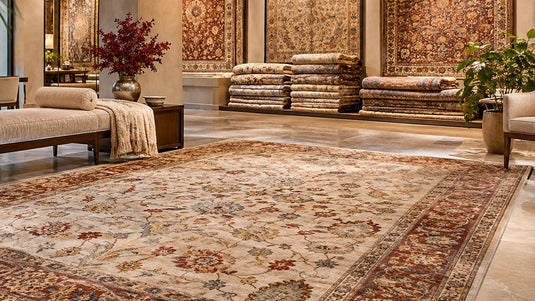
If you are comparing handmade wool carpet prices in India, you may notice very different quotations for rugs that look similar in photographs. That does not necessarily mean one seller is overpriced. Construction, fibre, size, design, finishing and customization can all change the final quote. Use this guide to ask better questions before requesting a price.
Size is a major cost driver
A larger rug usually needs more raw material, weaving or tufting time and finishing work. Compare dimensions using the same units. A 6×9 ft rug covers 54 square feet, while an 8×10 ft rug covers 80 square feet—almost 48% more area. But prices do not always increase linearly, because design complexity and construction also matter. Before comparing, check whether fringe or borders are included in the measurement.
Construction changes labour requirements
Hand-knotted rugs involve individually tied knots and can require considerable skilled labour. Hand-tufted rugs use a different process and may be priced differently. Handloom weaves create additional styles and textures. Do not judge only by a marketing label: ask how the rug is constructed, which fibre is used and what the backing or foundation includes. Intricate patterns may demand more work than simple designs in the same size.
Fibre and finish affect the quote
Wool quality, preparation and finishing can change appearance and price. Silk and bamboo silk details introduce visual sheen but may also affect production and care considerations. Clipping, washing, carving and finishing techniques influence labour and texture. A detailed quotation should specify the actual material composition; the words premium and luxury alone do not let you compare two products fairly.
Custom work should have a clear scope
A custom order may require drawings, colour matching, samples or special dimensions. Before approving a quote, request a written summary of the exact size, design, material, construction and revision process. Ask whether shipping, taxes and any customization fees are included. Timelines should reflect the actual production process rather than a generic promise. Make sure changes after design approval are documented.
Compare total value, not just sticker price
Consider expected use, care, ability to repair, return terms for ready stock, and after-sales support. A lower-cost rug that does not suit the room may be poor value; a more expensive one with a delicate fibre may also be the wrong choice for a busy household. Keep one common specification sheet for all comparisons. If the carpet is for a larger project, include installation and logistical requirements.
How to request a useful quote
Share your city, floor plan, approximate dimensions, material preference, desired design and budget range. If you like a product in the online catalogue, include its name or link. Ask for available standard sizes before requesting bespoke work. This lets The Ambiente team recommend comparable choices without guessing what you need. Exact current prices should come from the live product page or a confirmed quotation—not unsourced estimates.
Detailed buyer considerations
How to compare area correctly
Always calculate the actual area before comparing quotes. A rug measuring 5×8 ft covers 40 square feet; an 8×10 ft rug covers twice that. But proportional area does not automatically imply a proportional price because intricate knotting, border detail and finishing can introduce additional labour. Confirm whether the measurements are nominal or exact and whether the fringe is included. For an irregular or round design, ask how the area is calculated for pricing. Using the same unit of measure across quotations prevents avoidable misunderstandings.
Questions about wool and blended materials
Ask whether the rug uses pure wool in the pile, wool blended with regenerated cellulose-based bamboo silk, or a wool-and-natural-silk construction. The fibre mix can affect texture, sheen, cleaning requirements and the production cost. A seller should be able to specify whether a lustrous material appears throughout the design or only in selected accents. If the composition is not clear, request it in writing. Two similarly coloured rugs with different fibres should not be treated as direct price equivalents without understanding the practical and visual differences.
What to include in a bespoke quotation
For made-to-order work, ask for the artwork or design reference, final dimensions, material, construction technique, colour approvals, finishing details, tolerances and estimated production timeline. Clarify whether a sample is available and whether revisions after approval affect the price. Taxes, packaging, delivery, installation or special handling may be separate considerations. Request a final specification sheet so the approved project can be compared with the delivered rug. This matters particularly for architects, hotels and other commercial projects with fixed design requirements.
How to assess a price without false benchmarks
Do not rely on a broad online claim that every handmade wool carpet costs a particular amount per square foot. Construction and quality vary widely, and a price list can become outdated. Instead, obtain quotations for comparable designs from the same size and fibre category. Compare craftsmanship, finishing, seller information, care requirements and after-sales support. If a quote seems unusually low or high, ask which specification accounts for the difference. A transparent explanation is more useful than a label such as cheapest or most luxurious.
Set a budget around real needs
Start with the room and size you actually require, then identify which attributes matter most. If the main priority is a comfortable living room rug, an elaborate border may not provide extra value when most of the pattern sits under a sofa. If an intricate piece is central to a formal room, detailed handwork may matter more. Discuss acceptable design simplifications and alternative constructions before shrinking the rug to fit a budget. A correctly sized piece usually helps the room more than an undersized rug chosen solely to meet a price target.
A worked example for a real room layout
A buyer receives two quotations for an 8×10 ft wool rug. The first is a contemporary hand-tufted design with minimal colour changes; the second is a fine hand-knotted rug with intricate borders and silk detailing. Although the finished sizes match, their production effort, fibre composition and finishing differ. Rather than assuming the quotations are interchangeable, the buyer compares technique, fibre, design complexity, backing, delivery and aftercare. If the budget is constrained, the seller might suggest a simpler motif or a different construction without shrinking the required size. A written specification makes the compromise clear before the order is approved.
Five mistakes to avoid
- Comparing total prices for rugs of different areas. Before choosing, verify this point using actual room measurements, product details and care guidance rather than relying on a broad category label.
- Relying on an old or unsupported average price per square foot. Before choosing, verify this point using actual room measurements, product details and care guidance rather than relying on a broad category label.
- Failing to ask whether customization, taxes and shipping are included. Before choosing, verify this point using actual room measurements, product details and care guidance rather than relying on a broad category label.
- Ignoring the extra time required for intricate handwork. Before choosing, verify this point using actual room measurements, product details and care guidance rather than relying on a broad category label.
- Choosing a smaller rug solely because it is cheaper. Before choosing, verify this point using actual room measurements, product details and care guidance rather than relying on a broad category label.
Final five-step buying checklist
- Specify the exact size, including fringe expectations. This small check can reduce guesswork and helps the seller recommend suitable options rather than unrelated designs.
- Request the fibre and construction details in writing. This small check can reduce guesswork and helps the seller recommend suitable options rather than unrelated designs.
- Compare quotations using the same technical scope. This small check can reduce guesswork and helps the seller recommend suitable options rather than unrelated designs.
- Confirm all charges and production or dispatch timelines. This small check can reduce guesswork and helps the seller recommend suitable options rather than unrelated designs.
- Discuss alternative constructions if the preferred design exceeds budget. This small check can reduce guesswork and helps the seller recommend suitable options rather than unrelated designs.
Explore related handmade rug collections
Compare suitable patterns, constructions and available dimensions: Wool rugs | Hand-knotted rugs | Hand-tufted rugs. Check each product's material, size and care specifications before ordering.
Frequently asked questions
Are thicker rugs always better for winter?
No. Pile height, construction, fibre and the room's actual use matter more than thickness alone. Compare how the rug feels and how you will clean it.
Can I order a custom size?
The Ambiente offers custom rug enquiries; share measurements and the desired design so availability, specifications and timing can be discussed.
What should I send for a recommendation?
A floor-plan measurement, room photograph, preferred colours, city and approximate budget help the team propose suitable options.
Ask The Ambiente about the right rug for your space
We can help you compare available handmade designs, discuss bespoke dimensions and understand suitable construction options. Share your room photograph and measurements so recommendations reflect your actual layout.
Need help choosing the right rug?
Send your room measurements and placement photos to The Ambiente.
Chat with us on WhatsApp